









Jan 16, 2026
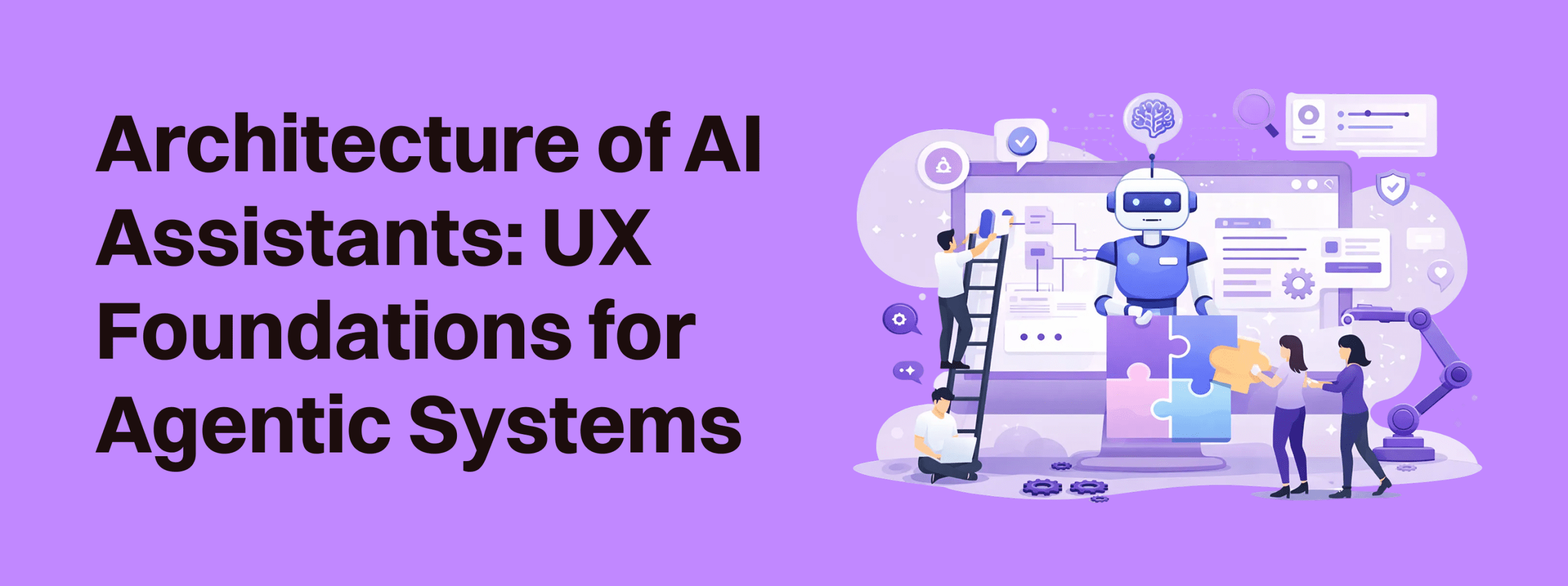
The most critical distinction for any product leader to grasp is the difference between a tool and an actor. Traditional AI—the kind found in most early co-pilots and generative text generators—functions as a tool. It exists within the boundaries of language modeling and text generation. It can analyze, summarize, or rewrite an email, but it has no inherent ability to manipulate the external world unless a human manually applies its output.
Agentic AI, by contrast, operates as an actor embedded in an environment. It does not just describe a path; it intervenes in it. An actor can navigate software, manipulate APIs, initiate financial transactions, and even control physical robotics. This transition changes the UX challenge from “how do we display information?” to “how do we regulate, sandbox, and visualize action?”.
When a system moves from description to action, the temporal structure of the interaction changes. A tool provides an immediate output. An actor performs multi-step workflows that may take minutes or hours to complete. This shift is essential to appreciating why traditional UX patterns fail in agentic systems.
| Feature | Traditional AI (Tool) | Agentic AI (Actor) |
| Default State | Reactive (wait for prompt) |
Autonomous (goal-seeking) |
| Operational Boundary | Language & Text Generation |
Environment Manipulation (APIs, UI) |
| Temporal Structure | Immediate, turn-based |
Multi-step, asynchronous |
| Human Role | User / Operator |
Supervisor / Collaborator |
| Primary Output | Information Display |
Operational Outcomes |
| Feedback Loop | Single output |
Continuous adaptation |
Anthropic and OpenAI have made this distinction explicit by describing models that operate as active participants rather than passive recipients of instructions. For a founder, this means your product is no longer just a “helper”; it is a digital employee. This realization pushes UX beyond aesthetics and into the domain of ethical responsibility, risk management, and collaborative autonomy.
Designing for autonomy requires a departure from linear user flows. In an agentic system, the user is no longer clicking through a sequence of screens to reach a goal. Instead, they are expressing an intent, and the system is determining the most efficient route to fulfill it. This requires an AI-first design mindset that prioritizes outcomes over flows.
Autonomy without transparency feels like unpredictability. If an agent is rescheduling a flight or moving funds between accounts without immediate supervision, the user must understand the “why” and “how” behind every action. Transparency is not about dumping technical logs onto a screen; it is about providing meaningful intent summaries and rationales.
Product teams must implement:
Real-time Status Indicators: Clearly show what the agent is doing at any given moment. For example, “Your travel assistant is currently comparing baggage fees for three airlines”.
Rationales and Intent Summaries: Provide the “why” behind an action, such as “Rebooking due to weather disruption forecasted”.
Detailed Visibility of Perception: Show the agent’s perception of the environment and its level of confidence in its intended actions.
Audit Logs and View History: Maintain a viewable history of all autonomous actions taken so users can verify decisions made while they were away.
Unlike traditional software where the session ends when the tab closes, AI agents work across shifting timeframes and various applications. This introduces a context management challenge. If a user returns to an interaction after several hours, they need to know the current state of the objective without digging through pages of history.
Effective state management relies on persistent dashboards that summarize current objectives, pending actions, and upcoming steps. Natural language recaps are also essential. A simple summary like “While you were away, I confirmed your hotel and drafted the meeting agenda” bridges the gap between sessions and reinforces the feeling of a professional partnership. This alignment with ensures the system communicates with the nuance and clarity expected by high-level decision makers.
Autonomy must never lead to a loss of user agency. The interface must provide accessible but unobtrusive controls to intervene, pause, or override the agent’s decisions. This includes “safe rollback” mechanisms where a user can undo a chain of autonomous actions if the outcome deviates from their original intent.
Designers must also allow users to adjust parameters mid-task. If an agent is sourcing vendors, the user should be able to narrow the criteria (e.g., “Only look for local suppliers now”) without restarting the entire process. The most effective implementations keep humans “on the loop” rather than removing them entirely.
The relationship between a human and an agent should feel like a partnership. The tone should be confident but never authoritarian. The agent should express what it intends to do rather than assuming it has the final answer. Consistency in personality and responsiveness builds familiarity, which is essential for long-lasting, trustworthy relationships.
However, designers must avoid “unrealistic or uncanny anthropomorphism”. While the agent should use natural conversational patterns like turn-taking and contextual memory, it should remain authentic to its nature as an AI. Overly humanoid representations or simulated emotions can lead to unrealistic expectations and disappointment when the AI inevitably falls short of true human capabilities. Instead of pretending to have emotions, focus on mirroring human communication styles in ways that feel familiar and responsive.
Founders often fall into specific traps when moving from prototypes to enterprise-ready systems. Understanding these myths is the difference between building a scalable asset and creating an operational liability.
Many organizations attempt to “bolt on” AI to existing interfaces using a traditional, linear waterfall development approach. In reality, agentic systems are dynamic and objective-driven. Implementing them successfully requires abandoning months-long planning cycles in favor of rapid, daily iteration. Leaders must shift from rigid buildouts to using flexible tools that allow for testing use cases immediately.
There is a common misconception that you need a massive, public-facing deployment to prove value. Starting with internal use cases—such as contact center productivity or HR compliance—is often more effective for mastering the sequencing of technologies before facing the customer. For example, one enterprise reduced ticket resolution times from six weeks to one by focusing purely on internal workflows.
Humans often create “hobbled processes” to work around disparate legacy systems. Automating these existing “ruts” simply makes a bad process faster and limits ROI. Instead, leaders should look for better ways to complete the objectives buried at the center of the mess. This approach binds the business ecosystem by standardizing communications and creating feedback loops that evolve over time.
Real value comes from orchestration—multiple agents collaborating around shared objectives. For instance, in Contract Lifecycle Management (CLM), one agent might handle notifications while another maintains a change log. Success comes from coordinating these agents rather than accumulating individual “bots” for specific tasks.
Relying on a single provider’s “black box” is a strategic risk. True agency requires an open and flexible orchestration platform that allows agents to communicate with legacy systems and other agents across different providers. Leaders must prioritize interoperability through protocols like the Model Context Protocol (MCP) to avoid vendor lock-in and enable faster pivots as technology evolves.
The biggest barrier to agentic adoption is an unclear Return on Investment (ROI). Traditional ROI models that focus solely on direct cost savings often miss the broader strategic benefits of productivity, agility, and employee experience. Since 97% of senior leaders report positive ROI across their business functions, the goal is to shift from “experimentation” to “enterprise-scale adoption”.
To calculate the true value of an autonomous agent, founders should use a multi-year lens that accounts for initial implementation costs versus long-term scaling.
Investment must include software licensing, hardware or cloud infrastructure, initial training data preparation, and the ongoing cost of human oversight. Value is generated through several key channels:
| Metric Category | Specific KPIs for Decision Makers |
| Operational Efficiency |
Automation Rate (work completed without human help), Resolution Time Reduction, Cost per Transaction |
| Productivity Enhancement |
Increased Throughput, Cycle Time Reduction, Expanded Capacity without additional hiring |
| Quality & Compliance |
Error Rate Reduction, Avoidance of Compliance Penalties, Customer Satisfaction (CSAT) |
| Strategic Revenue Impact |
Increased Sales Conversion, 24/7 Service Delivery, Intelligent Upselling/Cross-selling |
For example, a Forrester analysis found that companies leveraging agentic AI for customer interactions saw an average 23% increase in conversion rates and a 17% improvement in average order value. Labor cost reductions typically range from 15% to 30% in applicable departments.
Speed to Outcome: How much faster can you complete a complex process?
Cost to Serve: How much cheaper is it to deliver the same outcome at scale?
New Capabilities: What can you do now that was previously impossible?. Examples include obtaining insights from decades-old documents or refactoring legacy code that no one dared to touch. These “net new” opportunities often provide the most transformative strategic value, even if they are harder to quantify immediately.
Before investing $10M+ into agentic systems—a benchmark 21% of organizations have already hit—founders must confront high-stakes questions that touch on strategy, risk appetite, and operating models.
What is our risk appetite for autonomy? Where are we comfortable letting agents act on their own, and where must human oversight remain?. Without this clarity, adoption either stalls through fear or creates dangerous exposure.
Can our agents work across fragmented systems? Real businesses rarely operate on unified, pristine data. Can the agent function inside the legacy systems and disconnected data stores that define your reality?.
How will this change our operating model? AI agents don’t just slot into existing structures; they break down silos and change decision rights. If an agent takes over the middle of a process, how must the roles around it be redesigned?.
Do we have the data foundation? Agents are only as good as the data and rules that shape them. Fragmented or poorly governed data leads to agents acting on bad information, which can mean anything from wasted spend to regulatory breaches.
At Redbaton, our approach to designing these complex, high-autonomy systems is grounded in deep user research and our proprietary KaiXen framework. We prioritize a “Quality Over Speed” methodology, ensuring that the initial phase of any project is dedicated to an in-depth immersion into your business goals. We understand that in the business of agentic design, less is often more—stripping away unnecessary elements allows the system’s main intelligence to shine through.
When we work with founders and product leaders, we focus on:
Detailed Discovery and Immersion: We don’t start with a solution; we start by asking questions that cut down on future back-and-forth between teams.
Lean UX and Iterative Sprints: We use weekly sprints to iterate on user flows, such as redesigning sign-up-to-payment paths to be completed in minimal steps.
Continuous Optimization: We view AI agents as living systems that require constant monitoring, UX audits, and lifecycle management.
Design-Led Stakeholder Alignment: We bring different stakeholders together to co-create experience principles and define the vision for autonomous solutions.
Our goal is to create work that people actually care about. Whether we are redesigning() or architecting autonomous recruitment platforms for global airlines, we ensure that every interaction is clear, professional, and built on a foundation of measurable business impact.
Agentic AI excels at multi-step reasoning and environment manipulation. Unlike traditional automation that follows predefined scripts, agents can coordinate across fragmented systems, negotiate incomplete information, and adapt to changing conditions—such as managing a supply chain disruption or identifying deviations from standard commercial terms in legal agreements.
Trust is built through visibility and accountability. This includes providing rationales for every action, real-time status updates, and viewable audit logs. Most critically, systems should have defined “bounded autonomy,” where they act independently in high-confidence scenarios but hand off gracefully to humans when ambiguity, risk, or human emotion demand oversight.
The primary barriers are concerns over data privacy, risk of hallucinations, and a shortage of specialized AI skills. Additionally, many organizations struggle with “data debt,” as agents expose gaps in data quality and governance faster than any traditional dashboard.
Interoperability is achieved through open orchestration layers and flexible platforms that support standard protocols like the Model Context Protocol (MCP) or Agent2Agent (A2A) communications. This avoids vendor lock-in and allows agents to manipulate software, APIs, and live environments as active participants.
Enterprises typically achieve a 20–40% improvement in automation rates. While direct labor cost reductions are common, the most significant ROI often comes from increased throughput, 24/7 service delivery, and the ability to scale operations without a proportional increase in headcount.
The transition to agentic AI is not an incremental update—it is the threshold at which technology moves from an assistive tool to an operational partner. The leaders who succeed will be those who stop designing for the machine and start designing for what the machine does when no one is looking. The future of UX is not just a better interface; it is the strategic management of autonomous intelligence.
If you are ready to move beyond reactive bots and architect a system that delivers measurable strategic value, let’s talk about your strategy.
Explore more in the complete Red Baton design library — every article, grouped by topic.


