












Dec 23, 2025
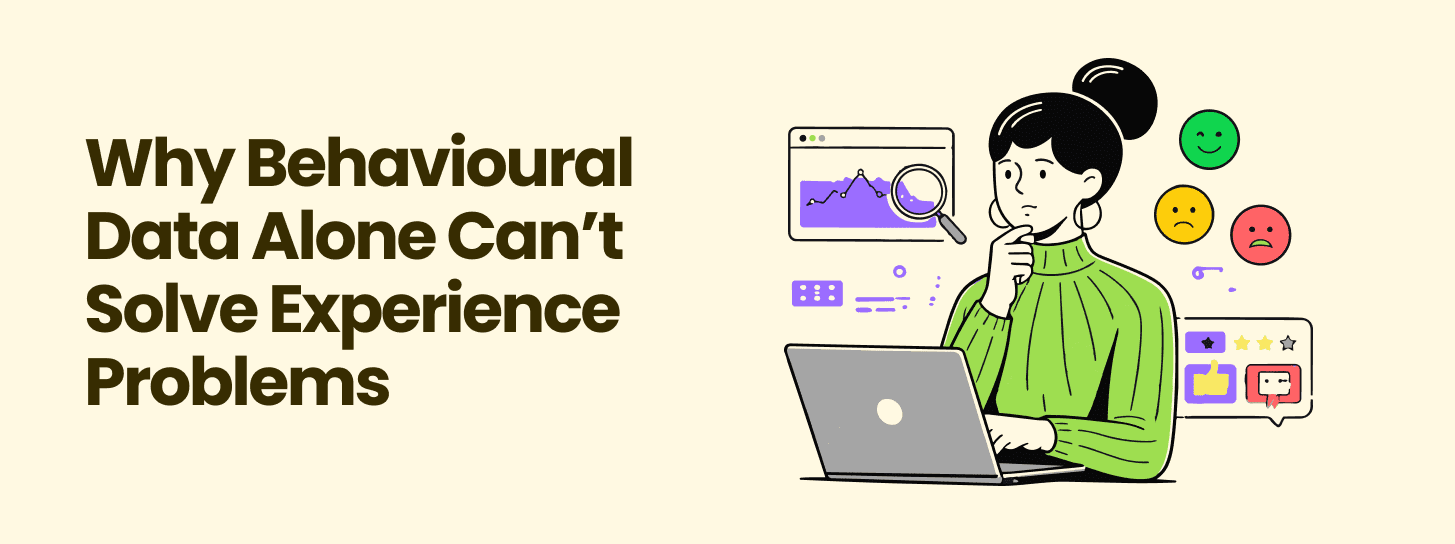
Behavioral analytics is the process of collecting and analyzing user interaction data—tracking clicks, navigation paths, drop-offs, and interactions to understand how people use a product. It is the “What” of the user experience. It tells you that 500 users clicked the “Add to Cart” button, but only 50 completed the purchase. While this is measurable and actionable for business impact, it creates a significant blindspot for product owners who assume that a high volume of clicks equals a high volume of satisfaction.
Observable behavior is often a reaction to a symptom, not the cause. For example, analytics might show a high dropout rate during onboarding. A product manager might assume the process is too long and shorten it. However, if the real frustration is that users don’t understand the value of the product before being asked for data, shortening the form won’t move the needle. Quantitative data alone highlights what is happening in user interactions but lacks explanation. It highlights that something is happening but leaves the reasoning in the mind of the participant—a place behavioral analytics cannot reach.
The primary danger is that numbers cannot replace humans. As appealing as quantitative research sounds, it is important not to lose sight of the people who generate that data. Data can help you understand what people are doing, but it cannot explain why they think or behave a certain way. For example, you might know that an app’s users tend to log on at specific times of day, but you don’t really know why they do that until you get a chance to ask some of them.
There is a concept in behavioral research called “Dark Data”—features that appear unused in your analytics but aren’t necessarily “bad”. A feature might be ignored because it isn’t discoverable, not because it isn’t valuable. If you rely solely on click rates, you might sunset a feature that would have been a game-changer for retention if it had just been positioned better. Conversely, behavioral analytics helps researchers uncover hidden friction, validate qualitative findings, and quantify the real impact of design decisions.
Common behavioral questions UX researchers aim to answer include:
Where do users drop off in a conversion funnel?
Which features are most used (and which are ignored)?
How long does it take to complete a key task?
What patterns differentiate high-value users from casual users?
Implementing these tools isn’t without technical and organizational hurdles. As products scale, the sheer volume of data becomes difficult to store and analyze in a cost-effective way. Only a small portion of the data created is actually stored because some generated data can be very difficult to capture largely due to data engineering limitations. Furthermore, data quality issues—such as incomplete or inaccurate data—can lead to misleading insights and flawed decision-making.
| Challenge | Impact on UX Decision Making | Key Consideration |
| Data Quality |
Incomplete or inaccurate data leads to misleading insights and flawed decision-making. |
Ensure accuracy and reliability of collected data. |
| Data Privacy & Security |
Increasing concerns require robust protection measures and regulatory compliance. |
Build user trust through transparent data practices. |
| System Integration |
Difficulty connecting behavioral data with existing technology infrastructure. |
Enable seamless data flow across platforms. |
| Actionable Insights |
Collecting data without meaningful application limits business value. |
Identify relevant insights that drive meaningful improvements. |
To build a product people actually care about, you must balance what users say (attitudinal) with what they actually do (behavioral). These two data types are often in conflict. Humans have imperfect memories and often struggle to explain their internal experiences; they may even alter their opinions to reflect social norms or agree with a researcher.
Attitudinal research includes methods that help researchers understand a user’s opinions, assumptions, and beliefs about the product. This gives researchers a subjective perspective of the users.
User Interviews: This is the most common qualitative research method, conducted in person or virtually. Researchers use this to understand the user’s viewpoint, digging deeper into their thinking by asking follow-up questions and responding to verbal and non-verbal cues.
Surveys and Questionnaires: While interviews understand the attitudinal approach of a single user, surveys help gather input from a broad user base. Surveys enable researchers to understand the perceptions and motivations of large populations and different audience groups.
Behavioral research examines observable behaviors and sheds light on how users navigate and use a product, revealing patterns and obstacles that might not be apparent by just asking them.
Usability Testing: Researchers directly observe users as they interact with a product to complete specific tasks, identifying usability issues and areas where users struggle.
Analytics: By aggregating data on where users click, move the mouse, or scroll, analytics highlight pages and features that users interact with naturally, as well as areas that are neglected.
Eye Tracking: This method tracks where and how long a user looks at different areas of a screen, offering insights into user attention and engagement.
The mismatches between user attitudes and user actions are often a great source of insights. If a user says a site is “easy to use” but your session replays show them fumbling through the navigation for three minutes, you’ve identified a critical cognitive load issue that an interview alone would have missed. Integrating both types of data—how people think or feel and how they act—is an inherent part of the user experience.
A/B testing is often treated as the holy grail of product optimization. It provides clear evidence and allows you to test new ideas with hard data that stakeholders love. However, A/B testing can be dangerous if it’s the only tool in your belt. It often leads teams to iterate toward a “local maximum”—also known as “putting lipstick on a pig”.
Every design is an implementation of a concept. It is foolish to judge the merit of a concept based on a single design implementation. For example, if you theorize that adding a description to an option will increase adoption of that option, but the description is presented in a manner that makes it look like an advertisement, it might be ignored. The concept was not bad, but the implementation failed. A/B testing will tell you the variant failed, but it won’t tell you the concept was still worth pursuing.
If your A/B test variations are based only on internal experience and opinion, there is no guarantee you are testing the most optimal design. You could spend all your time generating cause theories and then testing all of them: that is the “brute-force” approach. Haphazard A/B testing is the equivalent of throwing ideas at the wall to see which ones stick, an approach that increases the risk of user abandonment and poor experience.
Many A/B testing tools call off a statistically significant winner too early. To truly trust your results, you must consider the interval of the conversion rate. A conversion rate isn’t just a single number (e.g., 2.7%); it is an interval (e.g., 2.7% ± 0.8%). You can only be certain a challenger is better when its interval does not interfere with the interval of the default experience. Furthermore, most A/B testing tools are based on cookies, which creates issues in a multi-device world. A user might see a challenger copy on their work computer but complete the purchase on their home mobile device, which may show them the default experience. The conversion is then assigned to the default experience, even though the challenger persuaded them.
| A/B Testing Variation | Description | Primary Limitation |
| A/A Tests |
Comparing two identical designs. |
Used to ensure reliability of the tool, not to find a winner. |
| A/B/n Tests |
Comparing any number of variants against a control. |
Requires an extended period to achieve statistical significance. |
| Multivariate (MVT) |
Comparing multiple variables simultaneously (e.g., headline and color). |
Organizational challenge; hard to say why a particular combination won. |
| Split URL Testing |
Comparing two variants of an entire site. |
Requires a high level of traffic. |
At Redbaton, we advocate for Mixed Methods—the use of more than one method of data collection in a research study. This approach utilizes qualitative and quantitative approaches to enhance the trustworthiness of findings. We are guided by research and led by business strategy to create solutions rooted in science, design, and emotions.
Before touching a single pixel, research must be grounded in a foundation phase involving philosophical, inquiry, and research logic considerations.
Generative Research: Used early to discover what problems users have and why they matter (e.g., card sorting, moderated interviews).
Evaluative Research: Used later to test how well a solution works (e.g., A/B testing, tree testing, concept validation).
One of the most powerful mixed methods is contextual inquiry—observing users in their natural environments, such as offices or production floors. These field studies enable researchers to document workflows, interactions, and communication patterns to uncover insights that go beyond abstract conversations. This immersive method reveals how products succeed—or fail—within real-world contexts. This is how Redbaton simplifies life’s complexities—by strategically partnering with futuristic innovation and immersion in the uniqueness of individual projects.
B2B research is fundamentally different from B2C. You aren’t just dealing with a single user; you are dealing with decision chains, professional workflows, and unpredictable schedules.
Synchronous Research: Interviews and live demos are powerful ways to understand motivations and pain points. Mirroring the industry’s language builds trust and encourages users to share deeper insights.
Asynchronous Research: Surveys and remote tasks enable researchers to understand the perceptions of large populations. Longitudinal studies, like diaries, reveal long-term patterns that are impossible to capture in short sessions.
Accessing difficult-to-reach B2B roles requires specialized recruiters and CRM data to add precision. We always recommend over-recruitment to offset the inevitable cancellations and delays in B2B environments. Furthermore, modern teams apply AI for transcription and analysis (using tools like Otter.ai or TurboScribe) to automate coding and free researchers to focus on interpreting insights.
| B2B Research Method | Best For | Implementation Tip |
| Contextual Inquiry |
Understanding real workspace interactions. |
Observe users in their physical workplace. |
| Live Demos |
Capturing real-time reactions to features. |
Combine with interviews for motivation insights. |
| Video Diaries |
Capturing authentic behaviors remotely. |
Use platforms like Dscout or Indeemo. |
| Surveys |
Gathering measurable evidence to guide decisions. |
Use for large audience populations. |
Maturity models help product leaders understand where they stand relative to others and show a path to where they’re going. These models summarize shared attributes of companies just introducing design all the way to organizations that rely on design as a respected contributor to their balance sheet.
Product leaders should audit their maturity across several attributes:
Executive Attitude Toward Research: Is research seen as a cost or an investment?
Scope and Purpose: Is research used for tactical design tweaks or long-term strategy?
Staffing and Governance: Is there a dedicated team? How are insights managed?
Observe Work Practices: Shadow teams during projects to understand real workflows versus documented procedures.
Analyze Capabilities: Inventory the processes, people, and tools currently in use.
Assess Deliverables: Examine the quality and consistency of UX outputs; check if design decisions cite user research.
Survey the Organization: Gather perspectives from across the company on UX understanding and integration challenges.
Evaluate Integration: Track research frequency and impact on the overall product development.
| Maturity Level | Characteristics | Impact on Product |
| Laggard |
Executive attitude is indifferent or hostile; research is tactical. |
Low customer satisfaction; reactive decision-making. |
| Early/Progressing |
Growing recognition of value; initial staffing of researchers. |
1.9x more likely to report customer satisfaction improvements. |
| Modern/Visionary |
Research is a primary tool for innovation; strong executive support. |
2.3x more business opportunities by reducing time-to-market. |
Data is useless if it doesn’t lead to a decision. Successful synthesis requires moving beyond “vanity metrics” to understand why users act the way they do.
Thematic analysis is a UX method that helps find patterns in qualitative data like user interviews or B2B reviews. You gather data in textual form, tag relevant statements (coding), and identify themes based on the frequency of those tags. This allows you to synthesize findings into a manifesto about client needs. For example, a thematic analysis of Clutch reviews might reveal that clients prioritize “Expertise” (understanding and consulting) over “Selling” and “Buzzwords”.
When validating hypotheses, the quality of the insight is determined by the objectivity of the questioning.
Bad Practice (Leading): “Did you notice how easy it was to use the product?”
Good Practice (Neutral): “What was the experience of using the product like?”
Bad Practice (Leading): “Did you find the feature frustrating?”
Good Practice (Neutral): “Describe any challenges you faced when using this feature.”
Behavioral questions focus on what users actually do (not what they think they do), helping document actions and avoid guesswork. Instead of asking “Do you like this?”, a PM should ask: “When was the last time you used this feature, and what prompted you to use it?”.
In the digital era, user behavior analytics addresses critical business questions like feature popularity and navigation patterns, but it must be balanced against privacy.
Addressing security concerns is crucial for sustainable analytics implementation. Organizations must understand user concerns about data collection and take comprehensive measures to ensure personal information protection. Successful protection requires:
Regulatory Compliance: Strict data protection protocols.
Anonymization: Aggregating data to protect individual identities.
Transparency: Clear and transparent privacy policies that give users control over their data.
Ensuring accuracy and data integrity is essential for reliable insights. Organizations should implement systematic validation processes to identify inconsistencies from various sources and use automated cleansing techniques to remove duplicate or irrelevant data. Personal information is like money; it can be spent unwisely only once. Avoid collecting information that isn’t required and destroy older data routinely.
Redbaton places special emphasis on the use of research to develop strategies for simplifying the complexity of life through design.
The Shikhar app project involved developing a pinnacle of design excellence for Unilever retailers in India. The app allows retailers to easily purchase products digitally from wholesalers without depending on sales reps. Redbaton meticulously crafted an interface that not only pleases the eye but enhances user engagement, navigating through a harmonious blend of aesthetics and functionality. This transition from manual sales rep visits to a digital stock ordering system required a deep understanding of user-centered design (UCD) and site mapping to ensure retailers could track returns and place orders conveniently.
For an airline recruitment company, Redbaton revamped the user flow from sign-up to the payment page. Working in one-week sprints and conducting discovery meetings, the team reduced the sign-up process to less than three pages. The outcomes were measurable and impactful:
Social media engagement rate quadrupled.
Website sign-ups exceeded the benchmark by 5x.
The project was delivered on time and within budget, with high client satisfaction.
Redbaton redesigned nine WordPress and PHP websites for a business management company. After conducting discovery sessions and submitting wireframes, the redesign led to a 30% improvement in on-page time and an overall improvement in performance. This demonstrates the power of combining methodical workflows with technical expertise to create quality results that stakeholders approve of.
| Project | Industry | Primary Outcome | Redbaton Approach |
| Shikhar (Unilever) | Consumer Goods |
Simplified digital ordering for retailers. |
Scientific data analysis + artistic design. |
| Airline Recruitment | Aviation |
5x sign-up benchmark improvement. |
Methodology-driven flow revamping. |
| Business Management | Corporate Services |
30% improvement in on-page time. |
discovery sessions + structured wireframes. |
| YOURs App | Technology |
Research-led UX/UI design. |
Turnkey consulting for innovation. |
Why isn’t behavioral data alone enough for our product decisions?
Behavioral analytics tells you what is happening (e.g., users are dropping off) but lacks the “why” explanation. Numbers cannot replace humans; data can’t explain the unarticulated user needs or frustrations that underpin those actions.
How do we avoid the “local maximum” trap in A/B testing?
Inform your A/B testing with qualitative user research first. Haphazardly testing variations based on internal opinion is just throwing ideas at a wall. You must differentiate between a bad concept and a bad implementation.
What is the difference between attitudinal and behavioral research?
Attitudinal research measures what users say, think, or believe (e.g., interviews, surveys) and provides a subjective perspective. Behavioral research measures what users actually do (e.g., analytics, eye tracking) and is crucial for optimizing interface performance.
How do we conduct a research maturity audit?
Follow five steps: observe real work practices, inventory tools/people, assess the quality of deliverables (do they cite research?), survey organizational perceptions, and track the impact of research frequency on the roadmap.
What are the key benefits of a mixed methods approach?
Mixed methods enhance the trustworthiness of findings by combining qualitative depth with quantitative scale. This ensures your product is truly responsive to users’ needs and that business decisions are rooted in science and emotions.
Explore more in the complete Red Baton design library — every article, grouped by topic.


