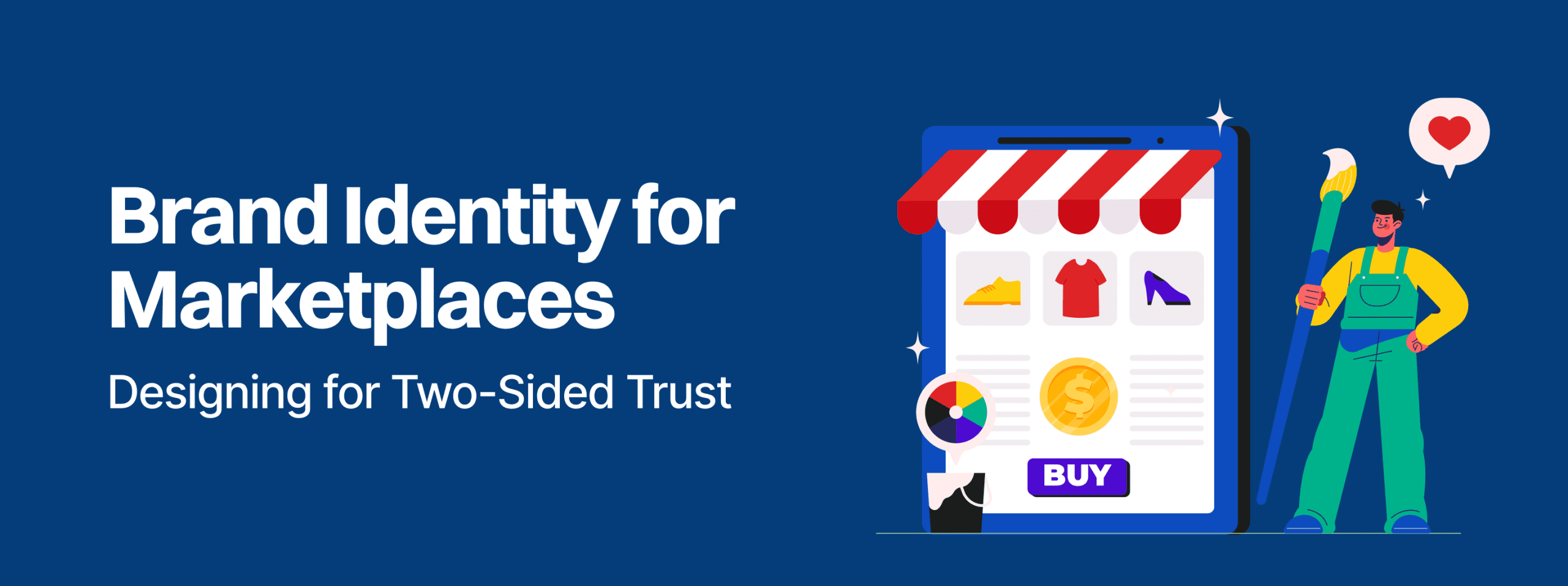
Marketplaces don’t just need to look credible—they must prove they’re safe and fair to two completely different audiences at the same time. A buyer won’t transact if they don’t trust the seller; a seller won’t list if they don’t trust the platform or the demand side. Marketplace brand design is fundamentally about engineering two-sided trust, not just choosing a logo and color palette.
Why Marketplace Branding Is Fundamentally Different
Traditional brands speak to a single primary consumer; marketplaces must constantly reassure both sides—buyers and sellers, hosts and guests, drivers and riders—often with conflicting needs and risk perceptions. A trust failure on either side triggers a full-system problem: supply churns, demand dries up, and unit economics collapse.
This means marketplace brand design cannot be “one-size-fits-all” gloss layered onto product. It has to be designed from the ground up to communicate reliability, safety, and fairness in every interaction, for every participant.
Understanding Two-Sided Trust in Marketplaces
For marketplaces, dual-consumer trust branding starts with recognizing that “trust” means different things to each side.
- Demand side (buyers/guests/riders) often needs:
- Safety and security (“Will I get what I paid for?”)
- Ease and predictability (“Is this going to be a hassle?”)
- Supply side (sellers/hosts/drivers) often needs:
- Fairness and control (“Will I get paid fairly and on time?”)
- Support and protection (“What happens if something goes wrong?”)
A single, generic “we’re friendly and modern” brand message usually fails because it doesn’t address these asymmetric fears. Dual-consumer trust branding requires a shared core promise expressed through role-specific assurances in UX, copy, and support policy.
Common Branding Mistakes Marketplace Founders Make
Most early marketplace brands struggle not because they lack a visual identity, but because they misdiagnose what their brand needs to do.
- Over-indexing on one side
Many founders emotionally identify with supply (e.g., hosts, creators) and unintentionally brand around them, leaving demand feeling like an afterthought—or vice versa.
- Confusing brand with UI polish
A sleek interface and nice illustrations are not a substitute for clear trust signals such as guarantees, insurance, or transparent policies.
- Treating trust as a feature, not a system
A “Trust & Safety” page or badge is not enough if onboarding, dispute resolution, and customer support contradict that story.
- Ignoring cultural and regional trust signals
Colors, imagery, tone, and even payment flows that feel normal in one market can feel risky or unprofessional in another. Ignoring local trust cues undermines global expansion.
The Core Pillars of Marketplace Brand Identity
Effective marketplace brand design rests on four non-negotiable pillars. Each must show up visually, verbally, and experientially.
- Credibility and Legitimacy
- Visual: Clean layouts, professional typography, clear data visualization (e.g., pricing breakdowns).
- Verbal: Straightforward, jargon-free language; clear promises and limits.
- Experiential: Reliable uptime, transparent status pages, predictable support.
- Safety and Transparency
- Visual: Trust indicators (badges, secure payment icons), clear affordances around identity verification.
- Verbal: Explicit explanations of policies, insurance, and protections in plain language.
- Experiential: Clear reporting flows, visible verification steps, real-time support in critical flows.
- Fairness and Neutrality
- Visual: Balanced layouts that don’t visually “side” with buyer or seller.
- Verbal: Neutral tone in disputes, transparent criteria for rating visibility and ranking.
- Experiential: Consistent enforcement of rules, clear appeal mechanisms.
- Community and Belonging
- Visual: Real, diverse people from both sides of the marketplace, not just polished stock photos.
- Verbal: Inclusive language addressing both roles (“hosts and guests,” “drivers and riders”).
- Experiential: Forums, educational content, and events that show the platform invests in both sides’ success.
If any pillar is only represented in visuals and not backed by UX and operations, trust erodes quickly.
Brand Identity Through a UX & Trust Lens
Marketplace UX branding is where identity becomes behavior. The most powerful trust signals are often invisible to brand decks but obvious in product flows.
Onboarding Flows for Both Sides
- Demand-side onboarding
- Show real-time supply quality (ratings, verification badges, volume).
- Set expectations clearly (what’s guaranteed, what isn’t, what recourse exists).
- Supply-side onboarding
- Clearly explain fee structures, payout timing, and ranking algorithms.
- Provide transparent guidance on how to succeed (how ratings work, what affects visibility).
The brand’s promise of fairness and opportunity must be felt here, not just read on a marketing site.
Verification, Ratings, and Reviews as Brand Signals
Verification flows should feel rigorous but respectful. Overly lax flows send a message that “anyone gets in”; overly harsh flows suggest the platform doesn’t value supply.
- Ratings and reviews need clear rules: what can be posted, what can be disputed, and how disputes are handled.
- Visual treatments (e.g., how you display 4.1 vs 4.9 stars) send subtle signals about quality and tolerance for risk.
These mechanics are your marketplace UX branding—more than colour palettes.
Tone of Voice in Trust Moments
“Trust moments” are places where stakes feel high: payments, cancellations, disputes, damage claims.
- Avoid defensive legalese; use calm, authoritative language that explains why a decision was made.
- Emphasize shared responsibility and process (“Here’s what happens next”) rather than blame.
Tone here either reinforces or contradicts your promise of fairness and safety.
Microcopy and Motion as Reassurance Tools
Microcopy and motion can reduce anxiety:
- Progress indicators for multi-step flows (e.g., listing creation, booking).
- Gentle motion on confirmation states (e.g., checkmarks, subtle success animations) to create closure.
- Clear error messages with guidance, not just red text.
When done well, these details make the brand feel competent and caring, reinforcing dual-sided trust.
Designing One Brand That Serves Two Audiences
The goal is not two brands under one roof, but one coherent brand with differentiated expressions.
- Shared brand core
One overarching promise (e.g., “safe, fair access to X”) and personality (e.g., calm, knowledgeable, approachable).
- Role-specific messaging
- For supply: “We have your back as you earn.”
- For demand: “You’ll get what you expect—or we’ll make it right.”
- Visual hierarchy for dual journeys
- Clear entry points: “I want to book” vs “I want to host.”
- Distinct but related visual patterns (e.g., color accents or icon styles) for each side that still feel part of one identity.
Differentiate experiences where motivations diverge (pricing dashboards, earnings insights, buyer protections), but keep the underlying visual language and tone unified.
Scaling Trust as the Marketplace Grows
As geographies, categories, and user segments multiply, trust can fracture if brand and UX guidelines are not built to scale.
- Brand consistency across geographies
Maintain the same core trust patterns—verification, guarantees, dispute flows—while localizing payment methods, support channels, and cultural cues (imagery, holidays, language formality).
- Managing trust during rapid supply or demand growth
- Resist the temptation to relax verification standards just to hit growth targets.
- Communicate proactively about changes in rules or protections when scaling quickly.
- Aligning product, marketing, and support under one trust narrative
Trust is only credible if all three tell the same story. If marketing promises “instant refunds” but support says “7–10 days,” the brand breaks.
Marketplace Brand Systems: What to Document
Marketplace brand design needs to be codified, not just understood by a few early employees.
Document at least:
- Trust principles and guardrails
- “We never obscure fees.”
- “We always explain why an account was suspended.”
- Visual and verbal do’s and don’ts
- How to show user photos, how to use trust badges, what language to avoid in high-stress flows.
- UX patterns tied to trust outcomes
- Standard patterns for verification, rating prompts, dispute resolution flows.
- When to escalate to human support.
- Collaboration models between brand, product, and ops
- Who owns trust policy decisions.
- How changes in ops (e.g., new fees, new protections) trigger updates to UX and brand materials.
This turns trust from a vague goal into an operationalized brand system.
Conclusion: Trust Is the Marketplace Brand
For marketplaces, “brand” and “trust” are effectively the same word. Logos, colors, and taglines matter only insofar as they reinforce what the product and operations actually deliver to both sides of the platform.
Marketplace founders who design brand identity and UX together—grounded in two-sided trust—build platforms that are harder to copy, more resilient to shocks, and more likely to sustain healthy economics over time.