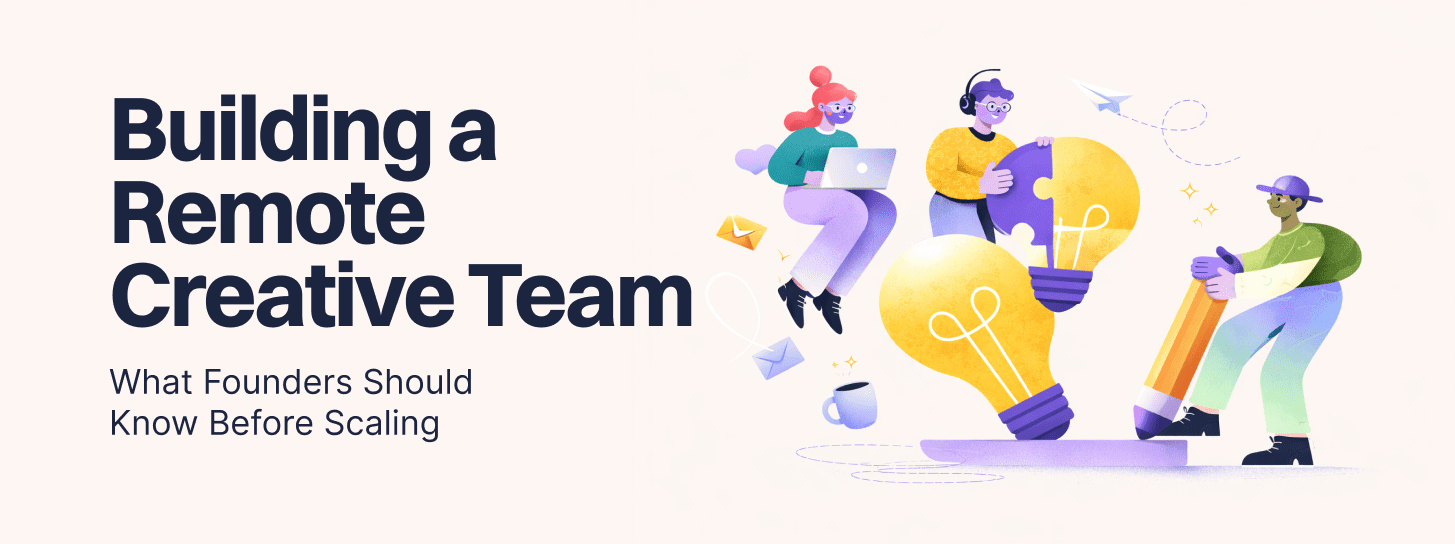
Remote-first creative teams promise global talent and round-the-clock output—but at scale, they often collapse under misaligned expectations, slow reviews, and inconsistent quality. A remote creative team is not just “designers on Zoom”; it is a deliberately designed system of roles, workflows, and rituals that can sustain quality and speed across time zones.
Why Remote Creative Teams Break During Scale
Early wins with one or two freelancers can mislead founders into thinking remote scales automatically. As headcount grows, so do:
- Conflicting interpretations of the brand
- Fragmented feedback channels (Slack, email, Figma comments)
- Bottlenecks around one “hero” designer or founder approvals
What worked informally at 5 people fails at 25. Without explicit design operations, a remote creative team becomes a throughput problem rather than a growth advantage.
What Makes Creative Work Harder to Scale Remotely
Unlike engineering tasks with clear done/not-done criteria, creative work is ambiguous and interpretation-heavy.
Key friction points:
- Ambiguity in creative direction
Vague asks like “make this feel more premium” lead to rounds of misfires and frustration.
- Feedback loops and subjective decision-making
Unstructured reviews devolve into opinion battles. Without criteria, decisions default to the loudest or highest-paid voice.
- Context loss across time zones
Designers miss live discussions; nuance gets buried in Slack threads or disjointed Looms.
- Misalignment between brand, marketing, and design
Brand sets one direction, growth wants experiments, product needs clarity—all pulling in different directions if not orchestrated.
When a Remote Creative Team Makes Sense (and When It Doesn’t)
A remote creative team is a lever, not a default.
Good signals you’re ready:
- Multiple channels (product, paid, lifecycle, social) require ongoing creative at volume.
- You have a clear brand foundation (positioning, visual identity, voice) documented.
- Work is repeatable enough to benefit from systems (e.g., recurring campaigns, product releases).
Risks of going remote too early:
- No clear brand or product strategy—designers have nothing stable to interpret.
- Founder-driven decision-making on every asset (creates bottlenecks and burnout).
- One-off projects instead of ongoing pipelines (freelancers may be better here).
Remote makes sense once you can describe what “great” looks like and can commit to consistent demand.
Structuring a Remote Creative Team for Scale
Treat structure as infrastructure. Start from outcomes, then map roles.
Core roles and responsibilities:
- Creative Lead / Head of Design
Owns quality bar, brand interpretation, and prioritization.
- Brand Designer
Maintains visual system, brand assets, and campaigns.
- Product/UX Designer
Owns product flows, design systems, and UX quality.
- Content / Motion / Specialized Roles (as needed)
Support specific growth levers (video, motion, illustration, etc.).
In-house vs freelance vs agency models:
- In-house: Best for ongoing core brand and product work.
- Freelancers: Ideal for spikes, experiments, or specialist needs.
- Agencies: Useful for big initiatives (rebrands, hero campaigns), not everyday iteration.
Define ownership and decision rights explicitly:
- Who signs off on brand integrity?
- Who can approve creative for go-live?
- Where can local marketers adapt without review?
Design a team topology that fits your org: hub-and-spoke (central creative hub supporting regional teams) or embedded designers per squad with a strong central standards function.
Managing Distributed Designers Without Killing Creativity
This is where managing distributed designers requires thoughtful structure, not micromanagement.
Clear Creative Briefs and Success Criteria
Every project should start with a written brief that covers:
- Objective and business impact
- Target audience and key message
- Constraints (channels, formats, deadlines)
- Success metrics (CTR, sign-ups, demo requests, etc.)
A good brief replaces 5 status meetings and makes async work viable.
Asynchronous Collaboration Best Practices
Lean into async by:
- Using shared docs or tickets as the “source of truth” (if it’s not in the tool, it doesn’t exist).
- Recording Loom or video walkthroughs instead of long alignment calls.
- Maintaining a clear status board (Notion/Jira/Asana) so everyone knows what’s in discovery, design, review, and QA.
Review and Feedback Frameworks
Avoid open-ended feedback like “I don’t like this.”
Use structured grids:
- What works (keep)
- What doesn’t (change)
- Questions (clarify)
- Decisions (final call)
Limit full-team crits for big work; smaller, focused design reviews reduce pressure and increase useful feedback.
Psychological Safety in Distributed Teams
Creative risk-taking dies when designers fear public criticism on calls or Slack.
- Encourage WIP sharing with clear framing: “early concept,” not “final.”
- Normalize iteration and protect designers from last-minute scope changes without renegotiated timelines.
- As leader, model specific, respectful critique tied to goals, not taste.
These are the remote design ops tips that separate high-performing teams from burnout factories.
Creative Operations: Systems That Make Remote Teams Work
Creative ops is the operating system for your remote creative team.
Key pillars:
- Design systems and brand guidelines
Shared libraries in Figma/Sketch with components, tokens, and patterns reduce decision overhead and maintain consistency.
- Asset management and documentation
Digital asset management (DAM) or disciplined cloud folders prevent version confusion. Document processes in a central knowledge base (e.g., Notion).
- Tooling (without over-indexing)
Choose a coherent stack:
- Figma (design),
- Slack/Teams (communication),
- Asana/Jira/Linear (project management),
- Miro/FigJam (workshops).
- Cadences, rituals, and checkpoints
- Weekly planning and prioritization.
- Regular design crits (live or async).
- Monthly retrospective on process, not just output.
Common Mistakes Founders and Marketing Leaders Make
Patterns show up again and again:
- Treating creative work like engineering tasks
Over-focusing on tickets and under-focusing on context leads to shallow work.
- Over-meeting or under-communicating
Too many calls exhaust designers; too few create disconnect. Balance with clear async channels.
- Relying on “hero” designers
One person becomes the bottleneck for every decision. Build shared standards and peer review instead.
- Scaling headcount before systems
Adding more designers without briefs, review frameworks, or a design system just multiplies chaos.
How to Measure Performance in a Remote Creative Team
Measure what matters, not who was “online longest.”
Output metrics:
- Number of assets shipped by type and channel.
- Time from brief to first concept, and from revision to approval.
Outcome metrics:
- Campaign performance (CTR, conversion, retention lifts).
- Internal satisfaction (stakeholder feedback on clarity, speed, quality).
Quality, speed, and consistency signals:
- Decrease in rework cycles per project.
- Improved brand coherence across channels (audit samples monthly).
Avoid vanity metrics like “number of Figma comments” or “hours on Zoom.” Focus on whether the remote creative team is helping marketing hit pipeline, revenue, or engagement goals.
Conclusion: Remote Creativity Requires Design, Not Hope
High-performing remote creative teams don’t emerge from hiring alone; they are designed. Founders and marketing directors must architect roles, rituals, and creative ops so distributed designers can produce their best work without burning out.
A remote creative team is a strategic asset when structured intentionally, measured thoughtfully, and supported by clear systems—not improvised across Slack and time zones