











Dec 1, 2025
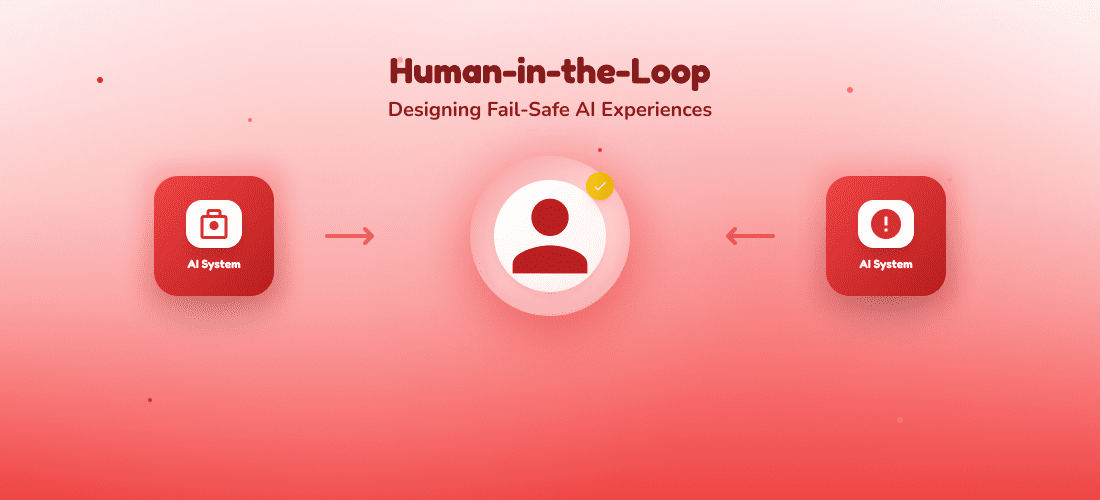
The enterprise AI deployment paradox is real. Organizations invest millions in machine learning models, AI-driven automation, and predictive analytics- only to discover that their greatest risk isn’t algorithmic failure. It’s human abandonment.
When AI systems fail without warning, or worse, when they succeed in ways users don’t understand, trust collapses. The design community faces an urgent challenge: how do we build AI experiences that users can’t just rely on, but actively want to control?
This is the landscape of human-in-the-loop UX design in 2025. And it’s fundamentally reshaping how enterprise leaders approach AI governance, product strategy, and organizational design.
A Forrester report from late 2024 revealed a sobering statistic: 65% of enterprise AI initiatives have experienced trust erosion within the first six months post-launch. The culprit? Not accuracy. Not cost. Opacity.
Enterprise buyers especially in regulated industries like financial services, healthcare, and insurance are increasingly risk-aware. They don’t want black-box AI. They want fail-safe AI experiences: systems with guardrails, transparent decision-making, and built-in fallback mechanisms that preserve human agency.
This shift moves human-in-the-loop design from a “nice-to-have” accessibility feature to a core business requirement. For product leaders and CPOs, this means rethinking the entire workflow architecture, not just the UI layer.
The traditional human-in-the-loop model is outdated. It positioned humans as validators reviewing AI outputs after the fact. This approach scales poorly, creates cognitive fatigue, and generates false precision (users approving things they don’t fully understand, just to clear their queue).
Modern risk-aware AI design operates on three distinct models:
Successful enterprise AI deployments in 2024–2025 (Anthropic’s enterprise partnerships, Databricks’ governance frameworks, IBM’s AI Trust & Transparency initiatives) are layering all three models, matching the depth of human involvement to the severity of potential impact.
Fail-safe AI experiences require more than monitoring—they require fallback mechanisms that work when AI fails. And they will fail. The enterprise question is no longer “if” but “how do we handle it?”
Control fallback UX is the design discipline that answers this. It includes:
OpenAI’s GPT integration in enterprise applications demonstrates this well. When GPT encounters ambiguous input or reaches confidence thresholds, the UX surfaces multiple options, explains reasoning, and enables users to refine prompts rather than accepting a single “best” answer.
One of the most under utilised tools in enterprise AI adoption is pilot mode design—a dedicated UX layer that enables organisations to test AI systems with limited scope, full observability, and explicit control.
Designing effective pilot modes requires rethinking traditional A/B test infrastructure. Pilot mode UX includes:
Zipwhip’s AI-powered messaging platform and Canva’s recent enterprise AI pilots both implemented sophisticated pilot mode designs, enabling rapid iteration while maintaining explicit human control—and both reported 3–4x faster adoption compared to traditional rollouts.
As AI risk becomes more tangible, a new UX discipline is emerging: governance UX.
Chief Risk Officers, General Counsels, and Compliance leaders increasingly demand the ability to configure, monitor, and audit AI systems without touching code. This has spawned a new category of critical interfaces:
AI Risk Dashboards: Real-time visualization of model performance, confidence distributions, failure rates, and user overrides. The best designs separate signal from noise—flagging only statistically significant anomalies rather than overwhelming users with metrics.
Policy Configuration Interfaces: Non-technical stakeholders should be able to define thresholds, exclusion rules, and escalation logic through guided UX flows. This is remarkably difficult to design well—it requires translating complex statistical and business logic into intuitive interfaces.
Audit Trail and Explainability Views: Every AI-driven decision should be auditable. Users should be able to click any decision and see: what input was provided, which model was used, what confidence score it generated, whether a human override occurred, and why. This enables both regulatory compliance and organizational learning.
Enterprise platforms like Databricks, Palantir, and emerging governance-first startups are pioneering this space. The organizations winning with AI in 2025 aren’t those with the best models—they’re those with the clearest governance UX.
At Red Baton, we’ve observed that enterprises treating fail-safe AI design as a post-deployment compliance exercise—not a core design problem—inevitably underperform. The most mature organizations integrate human-in-the-loop considerations from discovery through launch.
This means involving risk officers, compliance leads, and frontline users in early design sprints. It means prototyping governance UX alongside application UX. It means stress-testing fallback mechanisms before they’re needed in production.
The brands successfully deploying risk-aware AI in 2025 share a common trait: they designed for human decision-making first, and AI augmentation second. This inversion of typical product thinking—”How does AI solve this problem?” becomes “How does AI support humans solving this problem?”—fundamentally changes the UX architecture.
Year 1 (2025–2026): Establish Governance Foundations
– Design and implement AI risk committees with clear decision authority
– Build pilot mode infrastructure with observability by default
– Create policy configuration interfaces enabling non-technical governance
– Map high-risk workflows and implement human-in-the-loop checkpoints
Years 2–3 (2026–2027): Scale Trust-Driven Adoption
– Develop enterprise-grade audit trail and explainability systems
– Implement sophisticated fallback mechanisms across all AI workflows
– Build internal organizational muscle around AI governance UX
– Establish feedback loops between governance dashboards and product teams
Years 4–5 (2027–2029): Operationalise Autonomous Oversight
– Move from reactive monitoring to predictive AI risk management
– Implement self-healing fallback systems that learn from failures
– Develop cross-organizational AI governance standards
– Position AI as a competitive advantage within regulated industries through transparent, auditable systems
The organizations executing this blueprint won’t just deploy AI—they’ll build organizational trust in AI. That’s the differentiator.
Fail-safe AI experiences aren’t luxury features. They’re the infrastructure of enterprise AI adoption in a risk-aware era.
For CPOs, Heads of Design, and AI leaders evaluating AI implementation strategies, the question isn’t whether to invest in human-in-the-loop UX and risk-aware AI design. It’s whether you’ll lead the industry standard, or follow it.
The brands winning with AI governance and adoption in 2025 are treating it as a design problem, not a compliance problem. If your organization is exploring mature AI implementation, full-stack design and human-experience consulting isn’t overhead—it’s strategy.
Ready to design fail-safe AI experiences that scale? The most successful enterprises start with discovery: mapping your highest-risk workflows, understanding your governance maturity, and designing the trust infrastructure that enables velocity without compromising control.
Let’s talk about building AI systems that earn trust.


