










Dec 1, 2025
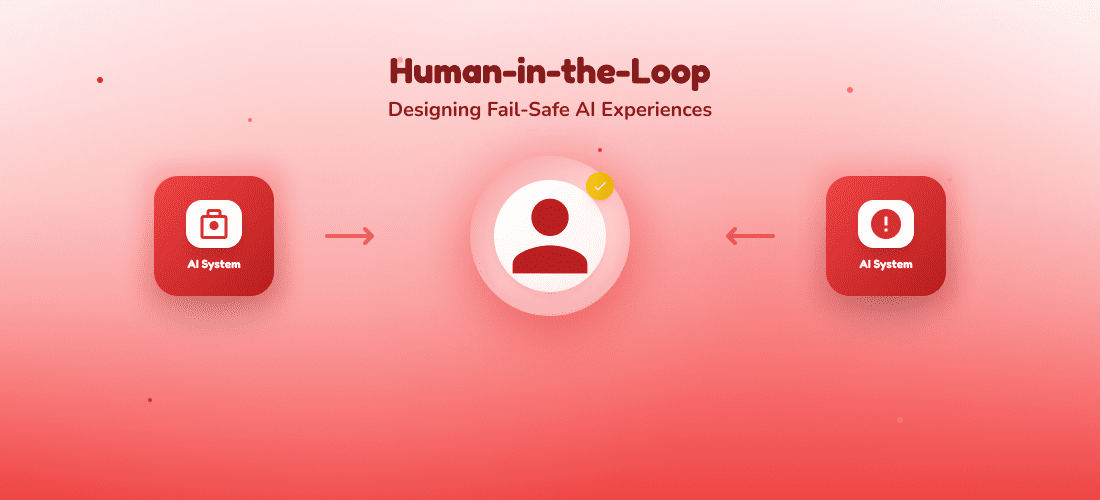
A dangerous misconception currently stalling enterprise AI progress is the assumption that the goal of technology is full automation—removing the human to let the machine run everything. Data from high-performing organizations suggests the opposite: the most successful AI deployments are those that are the most intentional about where humans remain in the loop. While AI can dramatically accelerate execution, it introduces three categories of risk that compound quickly: decisions made without business context, errors that scale at machine speed, and accountability gaps that cannot be delegated to a model.
Boards, regulators, and customers will always hold human leaders accountable for outcomes. AI cannot accept responsibility, which is why people must remain in control of decisions that affect the business, especially in regulated environments. The real value lies in designing processes that let AI handle structured work within clear limits while engineering human oversight checkpoints before deployment. Organizations that design oversight into their AI workflows from the beginning consistently outperform those that try to add governance controls after deployment.
At Redbaton, the approach to solving this paradox is grounded in understanding the specific “Jobs-to-be-Done” (JTBD) for each stakeholder. Instead of focusing on what the AI can do, the focus remains on what the user needs to achieve—the functional, emotional, and social outcomes they seek when “hiring” a solution. This mindset shifts the design team from asking “how can we automate this?” to “how can we empower the user to achieve this outcome faster and with more confidence?”.
| Feature | JTBD Framework | Persona-Based Framework |
| Primary Focus | The “Job” or outcome sought. | User demographics and traits. |
| Core Question | Why and when is the tool hired? | Who is using the tool? |
| Success Metric | Successful job completion/progress. | Empathy and user satisfaction. |
| AI Application | Focuses on automating high-friction tasks within a goal. | Focuses on personalizing the interface for the user type. |
| Risk Mitigation | Identifies critical “struggle” points for oversight. | Aligns AI behavior with brand and user expectations. |
Research indicates that blending these frameworks is the most effective way to navigate complex scenarios. Starting with JTBD to define core jobs and then using personas to detail the tactical flow ensures that AI systems are both strategic and empathetic. For example, a project management tool might expand from “solo task tracking” to “team async collaboration” by identifying the adjacent job of maintaining alignment in remote environments.
Trust in AI products is famously fragile. This fragility stems from the “Trust Trap”—a mismatch between user confidence and the AI system’s actual performance. When users fall into this trap, they either under-trust technology that could help them or over-trust algorithms that should be questioned.
Over-trust, or automation bias, occurs when users place excessive faith in a system’s accuracy, often signaled by a fluent tone or confident delivery. A notable case involved attorneys who over-trusted ChatGPT’s ability to provide legal citations, leading to the submission of fabricated references in a court filing. Conversely, under-trust happens when a capable AI system is ignored because its reasoning is “black-box” in nature. A highly accurate medical diagnostic AI might be disregarded by a clinician who cannot interpret its logic.
UX designers must act as a calibration mechanism, communicating what the AI knows and what it does not to keep users out of this trap. The goal is not just to build “trust,” which is a psychological state, but to foster “reliance,” which is the actual act of the user depending on the system for real-world decisions.
Building a trustworthy AI system requires moving from abstract ethics to concrete system qualities. Research from Carnegie Mellon identifies several measurable properties of trustworthy AI:
Neuroimaging research suggests that human-human trust activates brain regions linked to social cognitive load and emotional processing. However, high-quality user reliance on AI requires focusing on transparency and control rather than emotional trust alone. Ethical AI adoption requires aligning AI behavior with brand personality to ensure that every interaction reinforces the system’s reliability.
In an enterprise context, Human-in-the-Loop (HITL) means people sit inside the automation flow, not outside as a separate exception process. This model gives teams the steering wheel, allowing automation to accelerate without compromising safety. A robust HITL system pairs automation with checkpoints that route tasks to reviewers based on confidence, rules, or business impact.
To move from pilot to production, organizations must define tiers of decision-making, each with target thresholds and clear exit criteria.
| Tier | Task Type | Human Role | Threshold |
| Straight-Through | Low-risk, high-volume, repetitive. | Sampling and shadow review only. | High confidence (e.g., >95%). |
| Quick Check | Medium-risk, moderate impact. | Fast verification/approval. | Medium confidence (e.g., 70-95%). |
| Expert Review | High-risk, high-impact, ambiguous. | In-depth analysis and validation. | Low confidence or high-stakes flag. |
These tiers should be managed with “levers, not switches,” allowing organizations to adjust thresholds based on model performance and shifting risk postures. For instance, in financial crime alert triage, models score and cluster alerts, and analysts only review high-risk groups, cutting noise while keeping eyes on cases that matter most.
HITL starts long before deployment. Subject-matter experts must define tasks, supply examples, and build rubrics that guide model training. This upfront clarity reduces drift and surprise later. Post-production, human reviewers validate samples and tag “tricky cases,” which serves as high-quality training data for the next learning cycle. Every correction or reason code becomes a “data product” used to refine the model’s accuracy over time.
Designing for AI is not just about making a site look good; it is about ensuring it functions well and provides an intuitive experience that meets user needs. Modern AI products demand a new approach to UI/UX design that focuses on managing uncertainty and building calibrated trust.
To keep AI outputs in check, the “Governor Pattern” implements a human review step for AI-generated content. One effective approach is to show new AI-generated elements in a “provisional” state—dimmed or with an edit flag—until the user approves them. This builds trust and ensures better outcomes for complex or high-stakes tasks.
Milestone markers act as guideposts, nudging users toward potential next actions without trapping them in a rigid script. For example, an AI might suggest, “You’ve covered budget and timeline, but objectives are unclear,” while leaving the user free to choose their own direction. This combines personalized suggestions with the freedom to explore or ignore them, creating a collaborative dynamic that is more satisfying than full automation.
Empowerment comes from understanding. If an AI agent suggests a course of action, the interface should include an explanation or a “Why this?” link to reveal its reasoning. Progressive transparency ensures that users aren’t overwhelmed by technical details but can dive deeper when a decision is high-stakes or confusing.
A well-designed fallback, such as “I didn’t understand, can you rephrase?”, keeps users in control and demonstrates the system’s integrity. Interfaces must communicate uncertainty, confidence levels, and human override mechanisms. For example, in a medical triage AI, the system should predict likelihoods rather than certainties and provide clear paths for human intervention.
| Bad Practice | Fail-Safe Corrective | Impact on UX |
| Hiding model uncertainty. | Visual confidence indicators. | Builds calibrated trust. |
| Treating AI like static software. | Continuous learning feedback loops. | Aligns user expectations with model evolution. |
| Over-automation without control. | Mandatory confirmation for critical actions. | Prevents accidental data loss or permanent errors. |
| Poor failure handling/opaque errors. | Clear reason codes and fallback options. | Enables recovery and maintains user agency. |
Designing for Human-AI systems requires governance: designing for accountability, safety, and transparency so that unintended outcomes are anticipated and mitigated. Redbaton advocates for inclusive design and accessibility which extends to AI risk governance—ensuring that systems work reliably for all user groups without bias.
The SWIFT (Structured What-If Technique) method is a practical approach for identifying and assessing risks early in the design process. It involves asking team-based “what-if” questions to stimulate thinking about hazards:
Resilient systems are built on principles of modularity and redundancy. Redundancy adds extra components to take over functions if the primary unit fails, while graceful degradation allows systems to scale down operations instead of failing completely. Autonomous monitoring systems detect irregularities and trigger fail-safes, ensuring that the AI operates safely within predefined boundaries.
For example, in high-stakes software delivery, AI may create requirements and documentation, but product leaders check business goals before development, and engineers review and improve AI-generated code before deployment. This sequencing matters: AI becomes a force multiplier for disciplined teams, but a liability for those that mistake speed for strategy.
Explainable AI (XAI) is the ability to trace and interpret why an AI system produced a specific output. For enterprises, this means showing a regulator which training data shaped a credit decision or showing an auditor the reasoning chain behind an AI agent’s actions. XAI acts as the “trust layer” that turns analytics into repeatable, defensible decisions.
To close the gap between pilots and production, enterprises must move beyond simple dashboards to core technical capabilities :
Local explanations explain “why this single decision,” while global explanations provide insights into the patterns the model has learned overall. This dual view allows data scientists to debug models while business users validate decisions, boosting adoption because users feel in control rather than overridden by opaque automation.
In 2025 and 2026, enterprises are moving beyond simple assistants to “Agentic AI”—autonomous systems that plan, reason, and act within UX workflows. This represents a step-change where AI doesn’t just help with tasks but owns outcomes end-to-end.
This shift is often categorized into “Pilot Mode” and “Autopilot Mode” :
| Workflow Stage | Traditional UX | AI-Assisted (Pilot) | Agentic AI (Autopilot) |
| Planning | Manual layout and research. | AI-assisted brainstorming. | AI plans steps based on goals. |
| Execution | Designer creates everything. | Designer edits AI layouts. | AI executes and verifies steps. |
| Control | High human control. | Medium human control/speed. | Human as supervisor/curator. |
| Role | Creator. | Director. | Outcome Owner/Auditor. |
Tools like UX Pilot are already changing how designers work—shifting their role from drawing rectangles all day to focusing on psychology, storytelling, and usability. AI becomes a multiplier; “bad designers will generate bad AI designs faster, but good designers will create better designs even faster”. The future designer uses AI for base layouts and human judgment for the experience.
For executives, the real question is whether the system is fit for its intended purpose inside the organization. AI should be treated as a practical tool to achieve business outcomes—lower operational risk, reduced costs, or improved accuracy—rather than a headline for a board update.
Before building AI solutions, leaders must move beyond the hype and focus on real impact by asking :
Measuring the ROI of AI is challenging during the growth phase of experimentation. Instead, track these five metrics to understand the actual impact :
What does “Human-in-the-Loop” actually mean in a daily workflow?
It means people are integrated into the autonomous workflow at critical decision points. Instead of letting an AI agent execute a task end-to-end (like sending a contract), HITL adds a checkpoint for human approval, rejection, or feedback before the action is finalized.
When should we prioritize HITL over full automation?
Prioritize HITL in four scenarios: when the AI has low confidence or the input is ambiguous; when an action is sensitive (like deleting data); when there are regulatory/compliance implications; and when a task requires human empathy or context that models miss.
How do we prevent “Automation Bias” in our teams?
Automation bias—the tendency to over-trust the machine—is mitigated by designing transparent decision systems. This includes showing confidence indicators, explaining the system’s reasoning in simple language, and providing easy ways for experts to challenge or correct outcomes.
Does HITL slow down our speed of innovation?
Done correctly, it accelerates innovation by reducing rework and misalignment. HITL allows teams to move faster because they aren’t spending time fixing large-scale errors that a model made in isolation. It builds the governance and quality standards needed to scale from a pilot to a production system.
How do we handle model “hallucinations” in an enterprise environment?
By using a “Governor Pattern.” AI-generated content should be shown in a provisional state until a human validates it. Additionally, implementing XAI allows you to trace a hallucination back to the faulty training data pattern that caused it, allowing for targeted model retraining.
Explore more in the complete Red Baton design library — every article, grouped by topic.


