












Jan 5, 2026
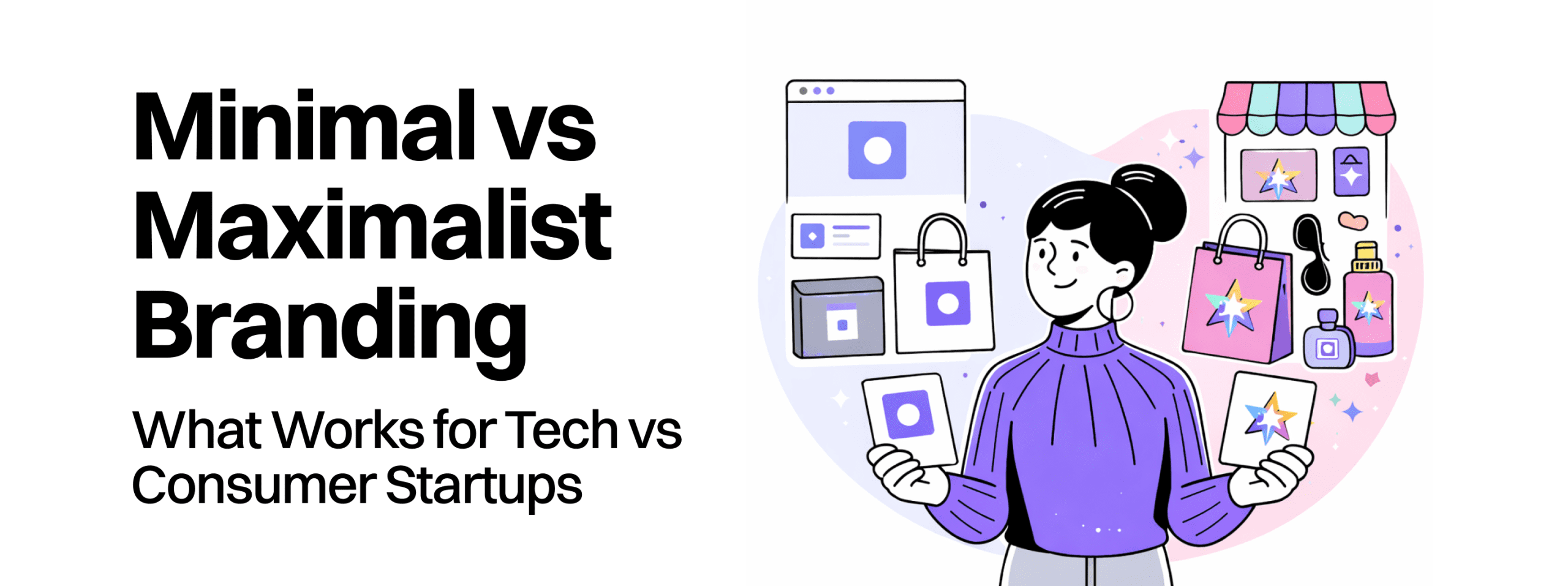
The brand style debate often reduces to aesthetics—clean lines versus bold visuals—but founders and CMOs miss the strategic core. Visual expression must align with business model, audience psychology, and market dynamics, not trends. Tech startups lean minimalist for credibility; consumer brands favor maximalism for memorability. Resolving this brand style debate requires tying choices to outcomes like trust, recall, and conversion.
Minimalist branding prioritizes restraint: sparse color palettes (often monochrome or 2-3 hues), ample whitespace, simple geometry, and functional typography. It signals precision and sophistication, stripping away excess to focus on utility.
Maximalist branding embraces abundance: layered textures, vibrant gradients, illustrative elements, varied typography, and dynamic compositions. It conveys energy and personality, using visual density to evoke emotion and narrative.
Misconceptions abound: Minimalism isn’t “lazy” or soulless—it’s deliberate hierarchy. Maximalism isn’t chaotic—it’s intentional storytelling. Both demand discipline; poor execution fails regardless.
Minimalist branding pros/cons center on scalability and perception.
Strengths:
Limits:
Success shines in tech: Early-stage SaaS prioritizes minimalist branding pros/cons favoring investor trust and UX focus. It excels for product-led growth where interface clarity drives activation.
Maximalism cuts through noise with visceral impact.
Strengths:
Risks:
Maximal brand identity case study: A direct-to-consumer apparel startup faced shelf commoditization. Shifting to layered patterns, bold typography, and lifestyle collages lifted social engagement 3x and repeat purchase 28%. Visual abundance mirrored product joy, turning commodities into aspirations—without sacrificing e-commerce conversion.
Tech demands minimalist dominance for product-led clarity. Investors equate restraint with maturity; cluttered visuals signal unpolished engineering. In SaaS landscapes, minimalist interfaces reduce friction—think Notion’s whitespace enabling focus.
Minimal wins early: Pre-PMF, simplicity proves execution over flash. Post-scale, it supports global localization without cultural misfires.
Exceptions arise: When differentiation hinges on personality (e.g., creative tools like Figma), add expressive layers—subtle gradients, playful icons—to humanize without overwhelming.
Consumer attention operates on entertainment economics—shelves and feeds reward boldness. Maximalism turns products into status symbols: vibrant packaging pops amid uniformity; Instagram stories thrive on visual drama.
It fosters community: Expressive brands become cultural shorthand, boosting UGC 2-4x. High purchase frequency benefits from emotional hooks—joyful visuals drive impulse.
Simplify when: Low-margin essentials (e.g., household goods) prioritize scannability over flair. Maximalism falters in trust-sensitive categories like health—restraint reassures. Align with market positioning for channel-specific tweaks.
Resolve the brand style debate with this matrix matching context to approach.
| Factor | Minimalist Fit | Maximalist Fit |
| Category Maturity | Mature/functional (fintech, tools) | Emerging/lifestyle (fashion, wellness) |
| Audience Sophistication | Expert/B2B (engineers, execs) | Mass/consumer (millennials, Gen Z) |
| Purchase Frequency | Infrequent/high-consideration | Frequent/impulse |
| Distribution | Digital/app-first | Retail/social-heavy |
| Differentiation Needs | Commodity risk high → Restraint | Standout imperative → Abundance |
Score your startup 1-5 per row; majority minimal → lean sparse. Test via A/B landing pages measuring engagement and trust. This framework ensures brand style debate yields data-driven choices.
Download the Brand Style Decision Matrix to determine whether minimal or maximal branding best supports your market positioning.
Audit quarterly: Does style reinforce or contradict market realities?
The brand style debate clarifies: Minimal suits tech’s clarity demands; maximal powers consumer connection. Neither triumphs universally—context dictates.
Founders and CMOs win by aligning expression with business levers: maturity, audience, channels. This strategic lens turns visuals into growth accelerators.


