











Dec 19, 2025
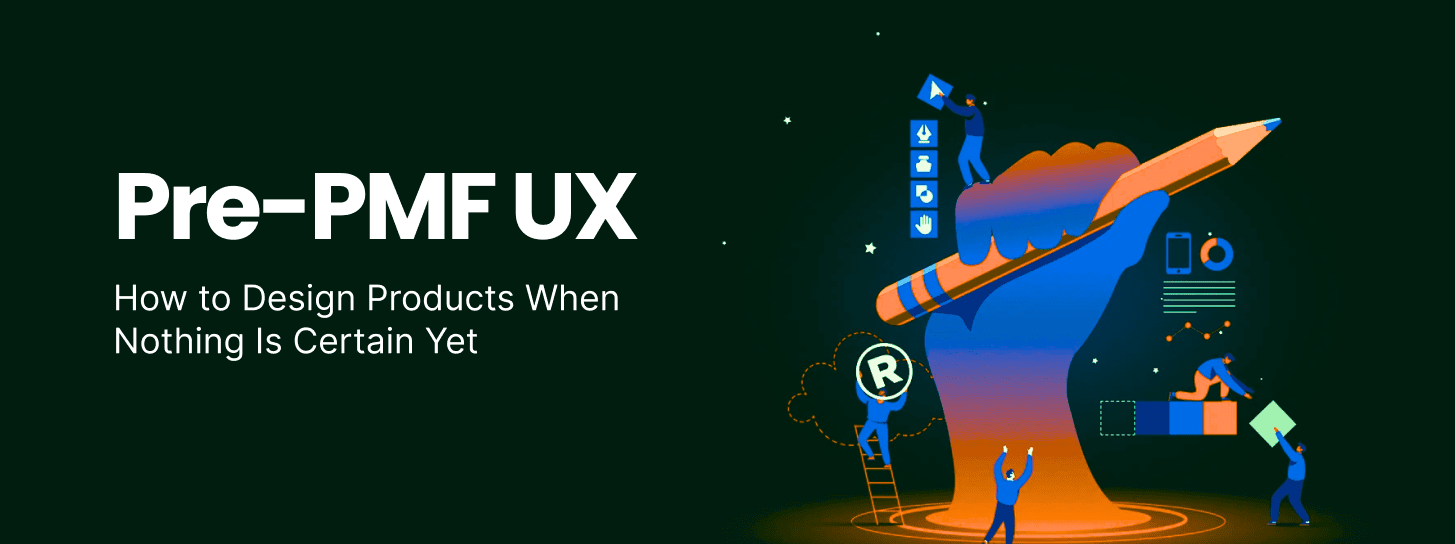
Designing a product’s user experience before achieving Product-Market Fit (PMF) can feel like navigating through fog — you don’t yet know who exactly your users are, what they want, or how your product will truly solve their problems. For seed-stage founders, this pre-PMF phase is a critical window where uncertainty is the norm and cautious experimentation sets the foundation for success. In this blog, we’ll explore how to approach pre-PMF UX design with practical strategies, focusing on lean UX and rapid experimentation to test assumptions and adapt quickly.
Product-Market Fit (PMF) happens when your product satisfies a strong market demand and resonates deeply with your target customers. But before this, in the pre-PMF stage, you’re shaping your product’s UX without fully understanding your users or the market. Pre-PMF UX refers to the user experience design process executed while your product’s value proposition is still being validated.
In this stage, UX designers and founders are not creating polished flows based on settled truths. Instead, they are building flexible, testable experiences that can evolve as insights come in. Pre-PMF UX is foundational, helping seed-stage startups reduce risks by identifying what truly works and discarding what doesn’t.
Uncertainty is one of the biggest challenges in early-stage startups. You likely have hypotheses about your users, the problems they face, and how your product can help — but none of these are guaranteed. This “unknown” phase is not a failure; it’s an opportunity to experiment.
Accepting uncertainty allows founders to:
Designing with uncertainty means your UX needs to be flexible, simple, and geared toward rapid iteration rather than guaranteed smoothness.
To succeed in pre-PMF UX, adopt a mindset rooted in experimentation and learning. Here are core principles:
Here’s a practical framework for seed-stage founders to design effective pre-PMF user experiences:
Before designing, write down clear hypotheses related to your users and product value. Examples include:
Listing assumptions upfront helps focus UX experimentation on what matters most.
Use paper sketches, wireframes, or low-fidelity digital tools to create simple representations of your product experience. Avoid building full-fledged user interfaces at this stage.
These prototypes should allow quick adjustments based on user feedback and serve as conversation starters during interviews or tests.
Reach out to early potential users and test your prototypes to learn about usability and desirability. Employ methods like:
Document insights specifically around which parts of your experience succeeded or caused confusion.
If your prototype runs on a platform where you can track user behavior (e.g., via analytics or session recordings), gather data such as:
Use this data alongside qualitative feedback to refine your UX hypotheses.
Take learnings from every round of testing to update your assumptions and designs. The goal is to get closer to what users truly need through a series of small, validated changes rather than one large redesign.
Lean UX is tailor-made for early-stage startups wrestling with uncertainty. It encourages building minimal designs, getting feedback faster, and pivoting early when something doesn’t work. Here’s how you can integrate lean UX and rapid experimentation into your pre-PMF UX process:
Imagine you’re building a new productivity app, but you aren’t sure if your target users want a step-by-step onboarding tutorial or prefer to explore the app on their own. Instead of guessing, you design two lightweight onboarding flows:
Using UX experimentation, you recruit early users via social media or email lists and split them into groups to test these flows. Track completion rates, user satisfaction, and qualitative feedback. If Flow A leads to higher retention but annoys some users, it gives you critical insight for further refinement.
Designing UX in uncertainty is less about nailing every detail and more about creating experiments that reveal truth. Seed-stage startups benefit enormously from viewing UX as a learning tool — not a final deliverable. By embracing assumptions testing and lean UX practices, founders can navigate early ambiguity with confidence.
If you want to supercharge your pre-PMF product design efforts, check out our PMF Hypothesis Testing Toolkit — packed with templates, experiment plans, and user research guides. It’s designed specifically for early-stage founders to move from guesswork to insight with agility and clarity.


