










Dec 24, 2025
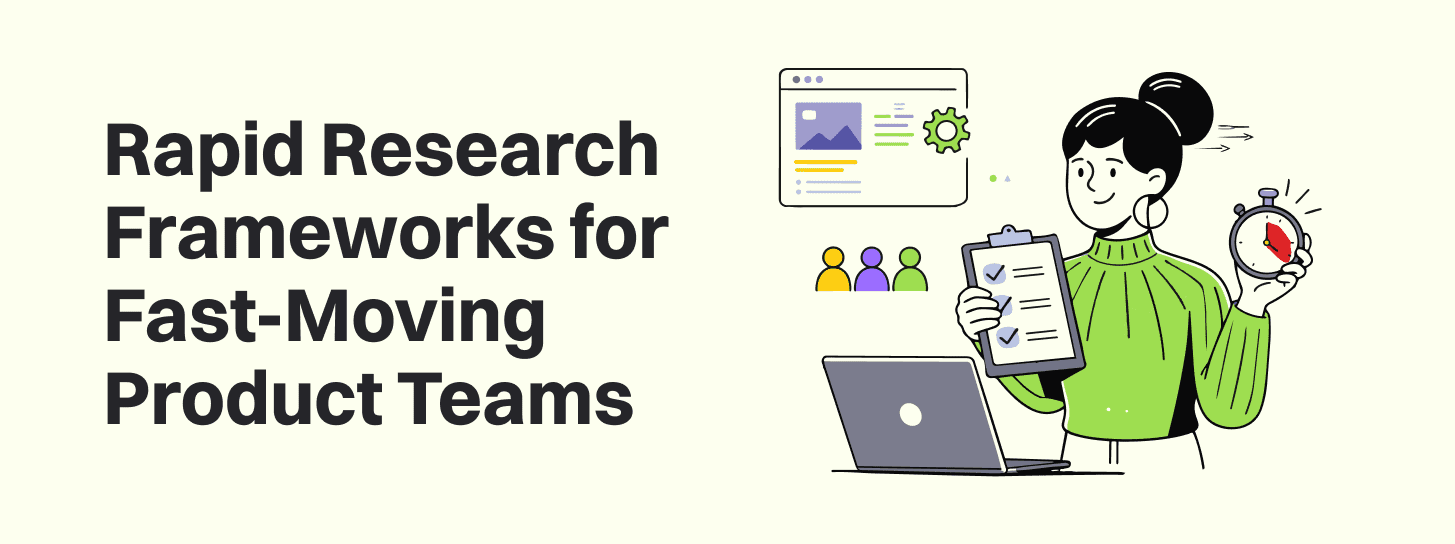
Rapid research is defined as a flexible framework for quickly executing UX research to gather fast, tactical, or evaluative feedback. Unlike traditional foundational research, which may spend months exploring broad human behaviors, rapid research focuses on specific, actionable questions that arise during the product development cycle. The intent is to accumulate “small research wins” that allow design and product teams to execute on decisions more effectively than through intuition alone.
Tactical research addresses immediate questions related to the usability and effectiveness of a specific feature or interface. It is highly evaluative and performance-driven. The primary methods utilized in this framework include:
The core differentiator of rapid research is the speed of delivery within challenging constraints. While traditional methods might require weeks of qualitative coding, rapid research relies on speed-driven synthesis to identify key themes, patterns, and anomalies in real-time. This process is often facilitated by technology, including automated analysis tools and predictive data models that help identify metrics faster than manual methods. The goal is to produce “stripped-down findings” that are efficiently contained and ready for immediate implementation by the product team.
Successfully implementing a rapid research program requires more than just a commitment to speed; it necessitates the establishment of dedicated Research Operations (ReOps) and clear team roles. Without a structured process, fast-paced research can quickly become chaotic, leading to shallow insights or skewed results.
Before launching a rapid framework, an organization must assess how fast its team can execute on findings and identify the existing backlog of research questions. Support from key stakeholders is critical to overcome skepticism regarding the value of high-speed evaluation. Product leaders must identify potential “naysayers” and develop strategies to demonstrate how rapid research protects resources and saves time by preventing the development of unused features.
Rapid research functions best when roles are consistent and cross-functional participation is high. Shuffling personnel frequently creates overhead in re-establishing expectations and knowledge sharing. A typical rapid research team should consist of:
Study Moderator: Leads the sessions and interacts with the participants.
Notetaker: Dedicated solely to capturing data during the session.
Designer/Prototyper: Prepares the artifacts for testing and iterates based on feedback.
Product Team Representative: Ensures the research objectives align with the product roadmap and business goals.
At Redbaton, the focus is on a methodical and structured workflow where young, multidisciplinary teams immerse themselves in the uniqueness of each project. This collaborative style combines scientific data analysis with artistic design to ensure results not only simplify complexity for the user but also help the company expand its customer base.
To maintain a 10-15 day cadence, teams must template as much of the process as possible. A bank of templates for research plans, recruitment screeners, and reporting formats allows the team to share tasks and participants efficiently. Furthermore, keeping a centralized research repository ensures that organizational knowledge is built over time, preventing teams from asking the same questions repeatedly.
A successful rapid research program operates on a tight schedule, often lasting only one week and rarely longer than a fortnight. The timeline must be rigorous to ensure that insights are delivered while the design is still being iterated upon.
While some teams iterate on a longer 6-week timeline initially, most mature programs aim for a 10-15 day cycle. A typical 5-day intensive sprint for evaluative research is structured as follows:
| Day | Focus | Key Activities |
| Day 1 | Planning |
Define the problem, research objectives, and specific questions. |
| Day 2 | Preparation |
Gather prototypes, recruitment of participants, and develop the test plan. |
| Day 3 | Execution |
Carry out the study (interviews or usability tests) with participants. |
| Day 4 | Analysis |
Synthesize the data and identify key patterns and themes. |
| Day 5 | Delivery |
Present findings and share actionable insights with the product team. |
Recruitment is the most common bottleneck in any research timeline. In a rapid framework, teams must utilize tools that allow for frequent, moderated studies and quick access to filtered participant pools. For instance, platforms like User Interviews facilitate finding, screening, and rewarding participants, which is essential for maintaining a fast-moving cadence.
The selection of tools directly impacts the scalability and speed of the research program. In 2025, the market for UX research platforms has shifted toward automation and seamless integration with design environments like Figma.
| Tool | Best Use Case | Key Features |
| Maze | Rapid Prototype Testing |
AI moderator, auto-drafted interview guides, Figma integration. |
| Lyssna | Rapid Design Feedback |
Five-second tests, first-click testing, preference testing. |
| Lookback | 1:1 Remote Interviews |
Real-time session recording, session replays, screen sharing. |
| Useberry | Prototype/Live Testing |
Heatmaps, scrollmaps, user flows, click tracking. |
| Trymata | Budget-friendly Testing |
Heatmaps, session recordings, conversion funnel analysis. |
| Loop11 | Hybrid Testing |
Audio/video for unmoderated studies, AI summaries, IA testing. |
Selecting the right tool requires balancing speed against depth. Maze, for instance, is highly regarded for speed and its Figma integration, making it a favorite for agile environments where teams need answers immediately. However, its focus on speed can lead to trade-offs in flexibility, such as rigid question structures and limited customization.
Conversely, Lyssna provides quick insights for specific questions regarding information architecture or messaging but lacks the tools for large-scale, in-depth testing. For teams needing more detailed qualitative data, Lookback offers a lightweight solution for moderated interviews and remote usability testing with strong video support. Optimal Workshop remains the go-to for specialized information architecture tasks like card sorting and tree testing.
AI has become a cornerstone of rapid research tools, transforming how data is processed. AI moderators can now help synthesize results and auto-draft interview guides, streamlining the manual aspects of research for teams without dedicated research staff. During the synthesis phase, AI is particularly effective at locating relevant literature and highlighting key materials, making the research phase more efficient and focused. However, human expertise remains essential for the actual decision-making and interpreting the “why” behind user behaviors.
For research to be effective, it must be integrated into the broader agile frameworks used by the development team. This ensures that UX research is proactive and preemptive rather than a reactive afterthought.
Scrum integrates UX by working in sprints and using ceremonies like daily standups and design reviews for collaboration.
T-Shirt Sizing: Many UX teams prefer using t-shirt sizing (S, M, L) over story points to estimate tasks like participant recruitment and usability sessions.
Dual-Track Agile: This involves running discovery alongside delivery. The discovery team (UX researchers and designers) continuously gathers insights, while the development team focuses on building the validated features.
Kanban visualizes the workflow with boards to reduce bottlenecks and track metrics like lead time. It is ideal for teams with continuous workflows rather than fixed sprints. Lean UX, meanwhile, focuses on outcomes over deliverables. It utilizes minimal documentation and fast iterations to obtain quick feedback, ensuring the product evolves based on real data.
In enterprise-level projects, SAFe emphasizes alignment and the connection of silos.
Alignment with Strategy: Research must be connected to business value, such as cost savings or revenue growth.
PI Planning: Program Increment planning brings multiple teams together to align on a shared vision and identify dependencies. UX must participate in PI planning to ensure the research roadmap aligns with product goals.
Product leaders must distinguish between research aimed at optimizing an existing product (Continuous Discovery) and research aimed at inventing a new one (Zero-to-One).
Continuous discovery is a process that never stops. It involves at least weekly touchpoints with customers by the team building the product.
Faster Answers: Because the team interacts with users weekly, they can get answers to doubts that appear during the design phase immediately.
Empathy and Intuition: Regular interactions sharpen the team’s sense of what to prioritize and what to ignore.
Iterative Exploration: Instead of relying on a single upfront phase, teams continuously gather insights to refine concepts throughout the development process.
Zero-to-One research represents the phase between an idea and the first shippable Minimum Viable Product (MVP). It is about creating something new rather than copying what exists.
Market Risk: The primary challenge is determining if anyone actually wants or cares about the product.
Vertical Progress: This is “intensive” progress that requires doing something nobody else has done before. It demands thinking from first principles instead of formulas.
The 10x Rule: For a new startup to succeed, the solution should offer a 10x value step-change over existing solutions.
| Criterion | Continuous Discovery | Research Projects (Foundational) |
| Cadence |
Weekly or Bi-weekly. |
One-off or long-term. |
| Risk Level |
Low-risk decisions (tactical). |
High-risk/Bankrupt-the-company decisions. |
| Goal |
De-risk the roadmap habit. |
De-risk a specific, large-scale feature. |
| Scale |
Small user samples (1-3). |
Large quantitative/qualitative scales. |
Despite the popularity of agile, many teams fall into “antipatterns”—pitfalls that lead to project failure and team burnout.
One of the most destructive antipatterns is the lack of a shared “Definition of Done” (DoD). Without objective, verifiable criteria, “done” means something different to everyone, leading to friction and features riddled with bugs.
Impact of DoD: A solid DoD prevents overcommitting and ensures that when an item leaves the backlog, it is complete.
Outcome: One startup cut post-release hotfixes by 40% simply by requiring a single peer code review as part of their DoD.
“ScrumBut” occurs when a team adopts Scrum but skips critical elements. Common failures include:
No Prioritization: Starting too many tasks at once, which leads to sprints that produce nothing working.
No Feedback Loop: Skipping retrospectives prevents the team from reflecting and improving their process.
Siloed Information: When teams work in silos, it leads to conflicting work and competing departmental priorities.
Solution Bias: Generating short-term research that is biased toward your own preconceived solutions rather than the user’s actual problem.
By 2025, the role of the product manager will shift toward a scientific, evidence-based approach where data-backed decision-making is critical.
AI is no longer a buzzword; it is a cornerstone of innovation. In 2025, SaaS platforms will use AI to offer predictive insights and automated workflows that adapt to enterprise needs.
Customer Retention: AI-native applications can reduce churn by up to 15% by anticipating client needs.
Operational Efficiency: For instance, Zendesk’s AI bots now resolve up to 80% of customer queries autonomously.
Vertical SaaS solutions, tailored to specific industries like HealthTech or FinTech, are dominating high-growth markets.
Specialization: These platforms address unique pain points, such as regulatory compliance in healthcare.
Scalability: The challenge for R&D managers in 2025 will be developing modular architectures that allow for rapid customization without ballooning costs.
In a highly competitive market, user experience has evolved from a “nice-to-have” to a necessity. With the average top-ranking page loading in 1.65 seconds, slow platforms risk losing enterprise clients immediately. Product managers must prioritize intuitive dashboards and mobile-responsive platforms to ensure adoption and retention.

Traditional research often involves long-term studies like longitudinal diary studies and complex usability testing that can take weeks or months. Rapid research is a week-long cycle focused on answering tactical, evaluative questions to meet the urgency of agile development.
By identifying pain points early, rapid research prevents the development of features that users do not need or value. It minimizes the risk of the “build trap,” reduces rework, and ensures that development efforts are aligned with business strategy and user value.
Use a full research project for high-risk decisions where a wrong move could bankrupt the company, or when starting in a completely new area where baseline knowledge is required. Rapid research is superior for tactical questions like UI intuitiveness, copy clarity, or validating existing knowledge.
Continuous discovery depends on the full involvement of the product manager, designer, and engineer. When all three engage in customer conversations together, decisions become collaborative by default, building trust and reducing back-and-forth later.
Yes. Rapid research is a lightweight process that saves time and protects resources. Many tools like Lyssna and Lookback offer affordable plans for teams of all sizes, and unmoderated testing can be used to gather data quickly without the high cost of laboratory testing.
Because rapid research relies on smaller participant pools and faster synthesis, there is a possibility of missing deeper nuances. Teams must balance speed with criticality, ensuring they do not let “incremental insights” lead only to incremental optimizations when breakthrough changes are needed.
Explore more in the complete Red Baton design library — every article, grouped by topic.


