









Jan 5, 2026
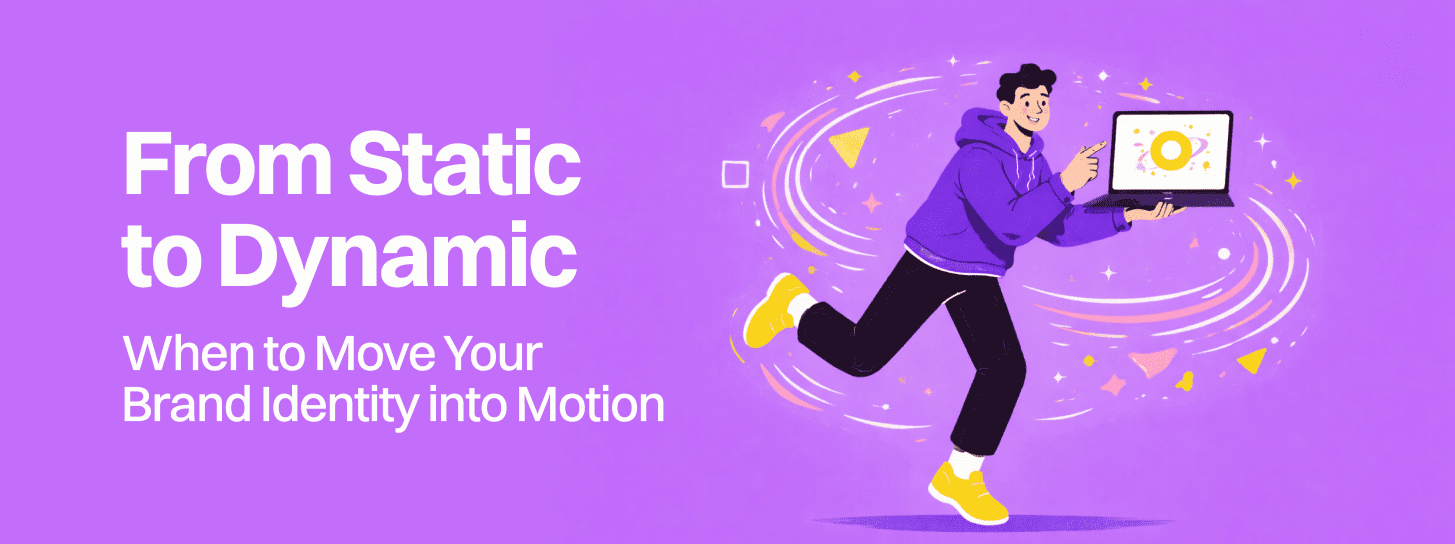
Static marketing materials, such as printed brochures and traditional billboards, have long served as the bedrock of brand communication, offering stability and consistency. However, the evolution of consumer behavior has rendered these “unchanging” assets insufficient for the high-velocity digital world. Motion branding has emerged not as a decorative trend, but as a strategic response to the dynamic nature of social media, video platforms, and interactive web interfaces.
The core issue lies in cognitive psychology. Humans are evolutionarily primed to respond to movement; motion triggers reflexive attentional shifts that static imagery cannot replicate. From a neuromarketing perspective, motion design simplifies complex ideas and drives emotional resonance, accelerating the buyer’s journey by tapping into primal brain responses. For B2B leaders, this means the ability to communicate complicated value propositions quickly and memorably.
| Element | Static Identity Impact | Motion Identity Impact |
| Attention Capture |
Passive; easily ignored |
Active; triggers reflexive focus |
| Message Retention |
Low (approx. 10% for text) |
High (up to 95%) |
| Brand Perception |
Traditional and stable |
Modern, premium, and alive |
| User Interaction |
One-way communication |
Two-way “lively conversation” |
Redbaton views motion as a fundamental layer of the brand experience, where design strategy is used to simplify life’s complexities. When motion is considered decorative rather than strategic, it fails to define how a brand behaves, missing the opportunity to establish a “kinetic identity” that governs rhythm and structure across every touchpoint.
For decision-makers, the transition to motion must be justified by measurable outcomes. The data suggests that motion design is a non-negotiable strategic asset for growth-focused organizations.
The impact on the bottom line is direct. Businesses that integrate animation and video into their marketing strategies grow revenue 49% faster than those that rely solely on static content. This acceleration is fueled by significant improvements in conversion rates; adding an animated component to a landing page can increase conversions by up to 80%.
In an attention economy, time is the ultimate currency. Users stay on pages with motion content three times longer than they do on static pages. Furthermore, motion graphics can increase general content engagement by up to 80%, leveraging the brain’s natural preference for narrative and movement.
Motion design also provides a return through cost reduction. By using animated product tutorials and micro-interactions, brands can clarify functionality and reduce user confusion, which directly leads to fewer support tickets and a lower cost-per-acquisition.
| Metric | Impact of Motion Branding |
| Revenue Growth Rate |
49% Faster |
| Landing Page Conversions |
80% Increase |
| Message Retention |
95% (vs 10% for text) |
| Engagement Rate |
38% to 300% Increase |
| Time on Page |
3x Longer |
Choosing between a static or dynamic logo is a strategic decision that depends on the brand’s maturity, market position, and primary communication channels.
Static logos, characterized by fixed shapes and colors, are highly effective for establishing foundational brand recognition. They are particularly useful for brands with strict budget constraints or those launching in traditional sectors where consistency and an “everlasting look” are prioritized. Nike, for example, has maintained its iconic swoosh since 1995 to build a globally recognizable mark. Static materials are the bedrock for:
Establishing brand awareness in high-traffic physical areas (billboards).
Broadcasting uniform messages to massive, diverse audiences.
Long-term visibility where frequent updates are not feasible.
Dynamic logos are adaptable entities that change based on context, user input, or platform requirements. This approach is ideal for tech startups, SaaS companies, and brands targeting younger, tech-savvy demographics. Dynamic identities are essential when:
Differentiating in a crowded, competitive marketplace.
Telling a nuanced brand story that requires more than a single symbol.
Creating a “premium” perception through smooth, elegant interfaces.
Localizing content for global audiences by adjusting cultural references in real-time.
A professional motion identity is far more than a “logo that moves.” It is a comprehensive system that governs how a brand expresses itself through time and behavior. At Redbaton, we believe research must guide these kinetic choices to ensure they are rooted in business strategy.
Every brand possesses a “kinetic signature”. A fintech startup may utilize snappy, efficient transitions (200–300ms) to mirror the speed and security of a transaction. Conversely, a luxury wellness brand might favor languid, 500ms easing curves to evoke a sense of calm and sophistication. Easing—the way an object accelerates and decelerates—acts as the brand’s body language, communicating confidence, playfulness, or restraint.
Behavioral branding involves defining how a brand reacts to the user across different contexts. This includes:
Loading States: Do they pulse, spin, or progress linearly?.
Hierarchy Signals: How do transitions guide the user from a parent page to a sub-section?.
Logo Entrances: Does the logo always enter from the same direction to build familiarity?.
For companies looking to transition, a “Motion Starter Pack” typically includes:
Animated Logo: 2–3 second animations that bring the mark to life across apps and decks.
Kinetic Typography: Text that moves to emphasize key messages and create rhythm.
Micro-interactions: Hover effects and button states that confirm user actions and build trust.
Motion Guidelines: A documented style guide defining timing scales and easing curves for future designers.
In the modern web, performance is the silent killer of conversions. If an animation takes longer than 3 seconds to load, 53% of mobile users will abandon the site. Founders must choose formats that balance visual fidelity with technical efficiency.
Lottie files are JSON-based vector animations that are 600% smaller than GIFs and significantly faster to ship. Because they are vector-based, they remain sharp at any resolution, whereas GIFs pixelate when scaled. Lottie files support a full alpha channel for perfect transparency, avoiding the “rough edges” common with GIFs.
GIFs are bitmap-based, meaning they store every frame as a full image, leading to massive file sizes (often 500KB to 2MB+). Large GIFs can devastate Core Web Vitals, specifically the Largest Contentful Paint (LCP) metric. Furthermore, GIFs are limited to a 256-color palette, resulting in inaccurate brand color representation.
| Feature | GIF (Bitmap) | Lottie (JSON/Vector) |
| File Size |
Large (e.g., 847KB) |
Tiny (e.g., 23KB) |
| Quality |
Pixelates when zoomed |
Sharp at any resolution |
| Transparency |
Limited (1-bit alpha) |
Full alpha support |
| Frame Rate |
15–24 FPS |
Up to 123 FPS |
| Load Time |
Slow (e.g., 3.2s) |
Fast (e.g., 1.8s) |
| Interactivity |
None |
Reacts to clicks/scrolls |
While Lottie is generally superior, it requires a small JavaScript player library (approx. 60KB) to render. On extremely old devices, this may lead to slightly higher CPU usage compared to native browser GIF decoding. However, for 99.5% of the modern web, the 97% reduction in file size offered by Lottie outweighs these concerns.
Founders often feel pressured to build a “Fortune 100” brand identity from day one. Redbaton recommends a staged approach, known as the “Brand Maturation Ladder,” which balances budget with growth.
Timeline: 1–2 days.
Goal: Validate product demand fast.
Outputs: Serviceable name, one brand color, classic typeface.
KPI: Landing page click-through rate (CTR).
Timeline: 2–4 weeks.
Goal: Professionalize what is working.
Outputs: Messaging system, identity refresh, basic asset kit.
KPI: Branded search trends and sales cycle length.
Timeline: 6–12 weeks.
Goal: Scale with consistency and deep engagement.
Outputs: Full motion guidelines, brand architecture, integrated product tutorials.
KPI: Brand recognition, LTV:CAC trends, and hiring metrics.
For global brands or major rebrands, this process can extend to 6–18 months depending on the number of stakeholders and complexity of the platform. Rushing through these phases can lead to a “cracked foundation,” requiring a rebuild later at ten times the cost.
Motion is a powerful tool, but without intention, it can overwhelm rather than enhance. Bad practices in motion branding can lead to “message loss,” where the product’s core value proposition is literally sliding out of focus because the background animation stole the show.
Over-Animating: Animating every widget on a dashboard can be charming at first but frustrating when a user is in a hurry.
Auto-Advancing Content: Carousels that move too fast force users to keep pace with the design rather than controlling their own flow.
Style Over Substance: A button that bounces for no reason can appear amateurish and distracting if it does not match the tone of the brand.
Ignoring Performance: Heavy JavaScript or unoptimized GIFs can cause noticeable “scrolling stutter” on mid-range mobile devices.
Accessibility Omissions: Failing to respect “prefers-reduced-motion” settings can cause physical discomfort for users sensitive to motion.
[ ] Every animation has a job: guide attention, signal change, or provide feedback.
[ ] Animations for UI elements are kept between 200–500ms for responsiveness.
[ ] Motion is considered from the outset, not “bolted on” months after launch.
[ ] Critical interactions have static equivalents as fallbacks.
[ ] Performance is tested across devices to ensure no “mobile lag”.
The digital design landscape for 2025 is shifting toward a balance of technical precision and emotional connection.
Flat design animation continues to dominate the corporate and B2B sectors. It allows businesses to present complex data in digestible formats that employees and clients can actually retain. Trends point toward “cozy minimalism,” featuring soft edges, rounded shapes, and warm colors that add personality without clutter.
A notable trend is the application of “kawaii”—the Japanese concept of cuteness—to logo design. Designers are adding facial expressions or human characteristics to inanimate brand symbols to make them feel more approachable and memorable. This anthropomorphic approach connects with customers by triggering a primal recognition of expressions.
2025 also marks a comeback for geometric shapes like circles and hexagons, conveying stability and strength. These are increasingly combined with 3D elements to add depth and sophistication, though designers must provide flat alternatives for contexts like screen printing.
“Modern-Retro” blends nostalgic elements with cutting-edge technology, appropriating mechanistic stories for new-age logos. This trend allows brands to leverage existing cultural trust while signaling innovation.
The launch of the Yulu Miracle demonstrates how a motion-first strategy can solve critical business problems and drive massive user acquisition.
Redbaton partnered with Yulu to redesign the app experience, focusing on building trust and providing instant gratification. Key implementations included:
Personalized Onboarding: Using short animated tutorials to simplify complex tasks like the first-time battery swap.
The “Nudge Me” Feature: A dynamic notification system informing users of bike availability to reduce zone frustration.
Animated Storytelling: Launching the Yulu Miracle with a motion graphics campaign that won multiple awards for its ability to cut through digital noise.
The project outcomes were transformative, demonstrating the power of motion when integrated into the product lifecycle :
Engagement: Social media engagement increased by more than 4x compared to the previous period.
Growth: Sign-up goals were exceeded by over 5x.
Award Recognition: The campaign earned several accolades, including the NYX Video Gold and Silver Awards and the Afaqs Foxglove Awards.
How does motion design impact business KPIs?
Motion design significantly affects the entire funnel. It improves acquisition by boosting landing page performance (up to 80% conversion increase), accelerates activation through onboarding animations, and improves retention by enhancing usability and message recall (95% retention).
What is the specific connection between motion and ROI?
Revenue for businesses using animation grows 49% faster. Additionally, motion reduces support costs by clarifying complex workflows, which decreases support ticket volume and improves the lifetime value (LTV) to customer acquisition cost (CAC) ratio.
How effective is motion for message retention compared to text?
Users retain 95% of a message when presented in an animation or video, compared to only 10% when reading text. This makes motion indispensable for B2B brands explaining technical or abstract concepts.
Does motion design affect brand perception?
Yes. Smooth, intentional, and elegant motion interfaces position a product as a “premium” offering. In contrast, poorly executed or gratuitous motion can make a brand feel amateurish and distracting.
Lottie vs. GIF: Which is better for performance?
Lottie is almost always superior for web and app use. It is 97% smaller, vector-based (no pixelation), and offers better transparency and interactivity. GIF should only be used for photographic content or very simple, non-essential animations.
How long does the branding process take?
A typical rebrand or brand development project takes 4 to 6 months. However, startups can utilize the “Minimum-Viable Brand” approach to launch in as little as 1–2 days, scaling to a solidified motion-first brand over 6–12 weeks as they validate their market.
Explore more in the complete Red Baton design library — every article, grouped by topic.


