Maritime
Revolutionizing maritime branding and customer experiences with advanced vessel management apps and next-generation onboard systems.
Maritime software carries a burden most enterprise tools do not: the people using it are often at sea, on intermittent connections, working long shifts against regulatory deadlines that carry financial penalties. Design decisions that would be minor annoyances elsewhere become operational risks here.
What makes maritime UX different
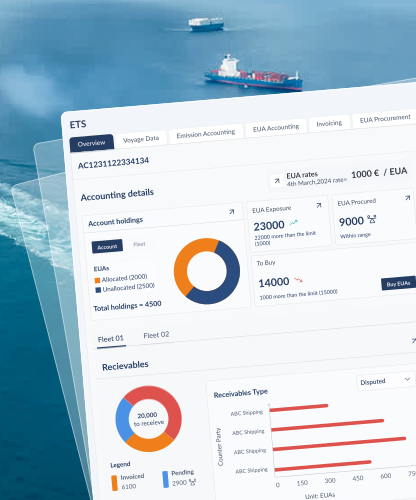
- Regulatory calculation is the product. Emissions accounting, ETS compliance and fuel reporting are unforgiving domains where a mis-read figure has audit consequences. The interface has to make the arithmetic legible, not just present it.
- Connectivity cannot be assumed. Vessel-side users need interfaces that degrade gracefully, queue actions and make sync state obvious rather than silently failing.
- Two very different audiences. Shore-side analysts want dense, comparative views. Crew need task-focused screens with minimal input. Serving both from one design system is the central architectural problem.
- Data density without overload. Voyage, bunker, cargo and compliance data all compete for the same screen. Progressive disclosure and strong information hierarchy matter more than visual polish.
How we approach it
We start by mapping the regulatory workflow end to end, because in maritime the compliance calendar — not the user journey diagram — is what actually structures the product. From there we design the calculation surfaces first: the tables, reconciliations and audit trails where trust is either earned or lost. Visual identity work follows the workflow, not the other way round.
Explore the maritime projects below to see this in practice.