










Dec 19, 2025
Traditional product discovery is typically executed as a discrete, time-boxed phase at the beginning of an initiative. In this model, a team might conduct a series of customer interviews, build a prototype based on the resulting assumptions, and then proceed to a launch-and-see stage. This approach creates a “fleeting glimpse” into the user’s world that rapidly becomes obsolete as market conditions and user behaviors evolve. Furthermore, project-based discovery often treats research as a hurdle to be cleared before “real work” (delivery) begins, which fundamentally ignores the reality that digital products are never truly finished.
Continuous discovery, by contrast, is defined by a minimum of weekly touchpoints with customers, conducted by the team actually building the product, in pursuit of a desired product outcome. This paradigm shift moves the organization from an “output-focus”—where the goal is the delivery of a feature—to an “outcome-focus,” where the goal is a measurable change in customer behavior that drives business value. By embedding discovery into the weekly operating rhythm, teams ensure that their decisions are powered by a nonstop influx of fresh user insights.
| Feature | Project-Based Discovery | Continuous Discovery |
| Cadence | Single “phase” at project start |
Weekly or bi-weekly rituals |
| Primary Trigger | New initiative or milestone |
Ongoing pursuit of an outcome |
| Ownership | Often delegated to researchers |
Owned by the PM, Designer, Engineer |
| Research Scope | Exhaustive, months-long projects |
Iterative, lightweight activities |
| Outcome | Validated feature requirements |
Validated behavior change (OKRs) |
The implications of this shift are profound for product velocity. While some teams believe that ongoing research hinders progress, the evidence suggests that skipping validation results in a “velocity trap” where teams move fast in the wrong direction. The dual-track approach allows discovery and delivery to happen simultaneously, ensuring that learning never stops and that the engineering team is always focused on the most valuable tasks.
A central tenet of effective discovery is the formation of a “Product Trio,” consisting of a Product Manager, a Product Designer, and a Lead Software Engineer. This cross-functional leadership model ensures that the three critical dimensions of a product—viability, desirability, and feasibility—are addressed in parallel from the very beginning. When teams work in silos, they often fall into a “daisy chain of responsibility,” where a designer spends weeks on a high-fidelity experience that an engineer later identifies as technically unfeasible, leading to significant wasted effort.
The integration of an engineer into the discovery process is particularly vital. Early involvement allows engineers to spot technical constraints or edge cases that might otherwise remain hidden until deep into the development cycle. Moreover, direct exposure to user pain points builds empathy within the engineering team, leading to more creative and technically elegant solutions that the Product Manager or Designer might not have considered. This collaborative partnership ensures that the team starts from the same set of assumptions and a shared knowledge base, which is essential for maintaining alignment as the project scales.
| Role | Primary Discovery Focus | Risk Mitigation Lens |
| Product Manager | Business Outcome & Strategy |
Viability: Will it work for the business? |
| Product Designer | User Experience & Pain Points |
Desirability/Usability: Do they want it? Can they use it? |
| Lead Engineer | Technical Logic & Architecture |
Feasibility: Can we build it with current tech? |
The product trio should be empowered to run their own research without the constant need for a centralized research team, which often acts as a bottleneck in fast-moving organizations. This autonomy allows the team to move from insight to action in a single sprint, rather than waiting weeks for a formal research report.
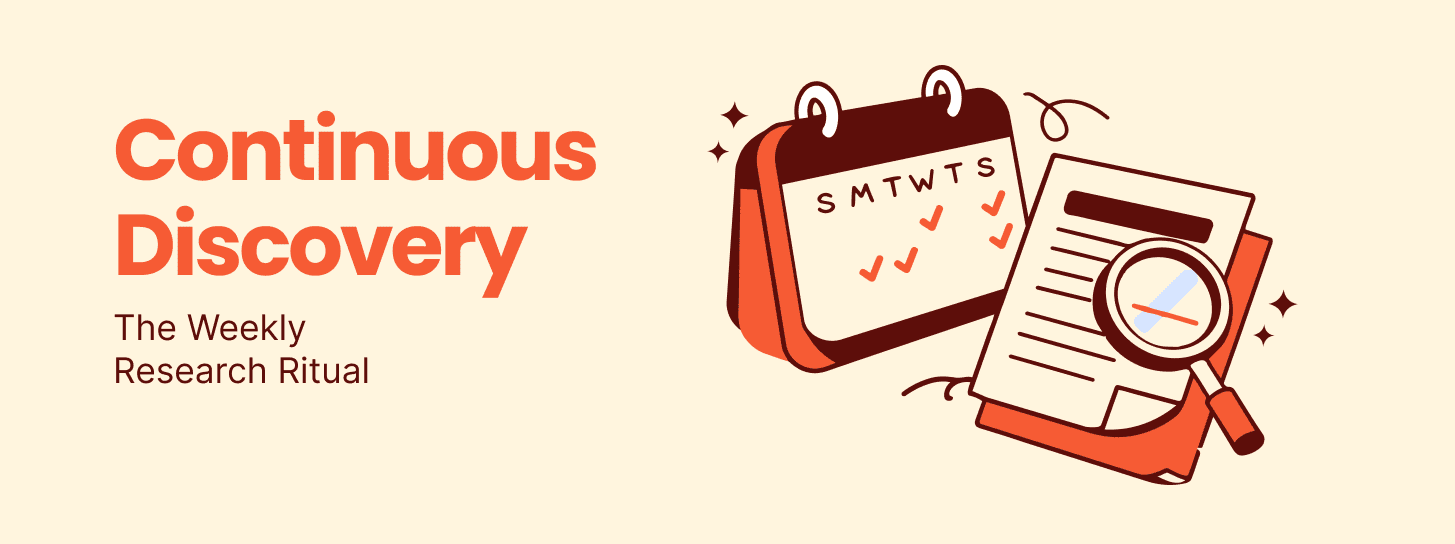
To sustain continuous discovery, it must be codified as a weekly ritual. Consistency is the primary driver of habit formation; doing discovery at the same time and place each week ensures it remains a priority even during busy delivery cycles. A successful weekly rhythm involves several discrete sections: processing loose ends, ensuring items are up to date, and generating new ideas to improve the work.
The goal of the weekly ritual is to learn just enough to inform the next decision. A structured approach, often derived from the “Weekly Touchpoint” model, keeps the team focused on outcomes rather than a rote set of questions.
Monday: Planning and Preparation. The trio reviews the Product Roadmap and aligns on the specific behavior they intend to change this week. They identify the “riskiest assumptions” that need testing and finalize the discussion guides or prototype prompts for the week’s interviews.
Tuesday – Wednesday: Customer Touchpoints. The trio conducts 1–2 short, focused interviews or usability tests. It is critical that at least two members of the trio are present—one to interview and one to take notes—to ensure a shared interpretation of the feedback.
Thursday: Synthesis and Assumption Mapping. Immediately following the interviews, the team creates an “interview snapshot”—a visual, easy-to-share reference that maps the customer’s experience and highlights key “opportunity” moments. They update their Opportunity Solution Tree based on these new insights.
Friday: Reflection and Backlog Refinement. The trio reviews what they planned to accomplish versus what was actually completed. They share weekly learnings during Agile retros or cross-functional meetings, using these insights to inform the next round of Product Backlog Refinement.
The most common reason teams abandon continuous discovery is the high friction of logistics, particularly participant recruitment. High-performing teams automate the “discovery logistics” while maintaining the “discovery love”.
| Logistic Step | Automation Strategy |
| Recruitment |
Use automated screeners or UX research opt-in questions at the end of existing surveys. |
| Scheduling |
Provide a Calendly link in the initial outreach to allow users to book immediately into pre-blocked slots. |
| Consent |
Automate the delivery of PDFs for consent and explanatory statements via email. |
| Data Storage |
Upload recordings to a centralized workspace (e.g., Dovetail or Notion) to prevent signal loss. |
By putting the weekly cadence on “autopilot,” the team can focus their cognitive energy on empathy and creative problem-solving rather than administrative tasks.
A common failure mode in product management is jumping into solutioning before framing the problem. Research indicates that approximately 75% of venture-backed startups fail, often because they build something nobody wants due to poor problem framing. The Opportunity Solution Tree (OST) provides a visual framework to ensure that every feature built is directly tied to a desired business outcome and a validated customer need.
Outcome: This is the top-level metric the team is held accountable for, such as increasing activation rates, improving retention, or driving monthly recurring revenue (MRR).
Opportunities: These represent customer pain points, needs, or desires. Opportunities are discovered through generative research and interviews where teams ask for specific stories rather than general ideas.
Solutions: These are the specific product features or interventions that could potentially address an opportunity. Teams are encouraged to generate 15–20 ideas for a single opportunity to push past their first, often least original, thoughts.
Experiments: These are the low-risk ways the team tests the assumptions underlying their solutions. Experiments allow the team to learn without writing a single line of production code.
Mapping the opportunity space allows the team to move from “Should we build this?” to “Which of these customer needs is most important to address right now?”. This visual alignment is crucial for stakeholder management, as it shows the “multitude of paths” the team can take to reach their desired outcomes, fostering creativity and reducing fights over whose idea is best.
The central goal of continuous discovery is the reduction of risk. Writing code is a slow and expensive way to find out an idea is wrong. Instead, teams should break their solutions down into smaller, testable assumptions.
Teams must evaluate their ideas against five categories of assumptions to ensure a holistic view of the product’s viability.
| Risk Type | Critical Question |
| Desirability |
Do users actually want or need this product? Will they get value from it? |
| Viability |
Will this generate sufficient revenue? Does it align with our business strategy? |
| Feasibility |
Can we build it with available resources and technology? |
| Usability |
Are users able to figure out how to use the product without assistance? |
| Ethical |
Is there potential for unintended harm? Does it align with our values? |
To prioritize what to test, teams should map their assumptions on a grid based on “Importance” and “Evidence”. The most critical assumptions are those with high importance to the project’s success but for which the team has the weakest evidence.
Weekly assumption testing might involve:
Unmoderated Testing: Posting a stimulus in the evening and reviewing the results the next morning to maintain a rapid pace.
Concierge Tests: Manually performing a task to test demand before building the automated version.
Landing Page Tests: Gauging market interest through sign-up rates for a proposed feature.
Story Mapping: Explicitly showing the steps a user must take to get value and reviewing each step for potential failure points.
By conducting small, frequent tests, teams can “fail sooner” on assumptions that would otherwise lead to expensive project failures later.
For decision-makers, the primary hurdle for adopting continuous discovery is often the perceived cost of ongoing research. However, a rigorous financial analysis reveals that the return on investment (ROI) for continuous discovery is driven by substantial risk reduction and the avoidance of wasted development resources.
A strong business case for discovery speaks the language of finance, utilizing terms like Net Present Value (NPV), Internal Rate of Return (IRR), and Payback Period.
Reduction in Cycle Time: Interactive discovery compresses internal approval cycles by 20–30% and can reduce the “time-to-first-value” for users by up to 40%.
Payback Period: For SaaS investments, a payback period of 6–12 months is typical. Continuous discovery ensures that features are adopted more quickly, accelerating the time until savings or revenue offset development costs.
Cost of Rework: Avoiding a single major project failure can pay for a researcher’s salary for an entire year. By identifying usability issues or a lack of market fit early, teams save millions in development resources that would have been spent on “fixing” a failed launch.
| Investment Area | ROI Driver | Financial Outcome |
| Staffing & Time | Risk Mitigation |
Higher NPV & lower project failure rates |
| Infrastructure (Tools) | Cycle Acceleration |
Faster payback period & reduced opex |
| Recruitment | Data Accuracy |
Higher LTV:CAC ratio (Ideal 3:1 to 5:1) |
Furthermore, the compounding effect of insight-driven development is significant. While paid acquisition stops generating leads once the budget ends, the insights gained from continuous discovery continue to drive product improvements that lower Customer Acquisition Cost (CAC) over time.
Adopting these rituals is not a linear journey; it is often messy and meets with significant internal resistance. Leadership must understand the common objections to effectively navigate the cultural shift.
Objection 1: “We need to ship faster, not spend more time in meetings.” The counter-argument is that speed without validation is merely a “feature factory” that leads to user and team churn. Moving fast in the wrong direction is a total loss of capital. Continuous discovery asks “What’s worth building at all?” rather than just “What can we ship in two weeks?”.
Objection 2: “Our customers are too busy to talk to us every week.” This is often a recruitment friction problem. When teams automate the process and respect the user’s time with short, focused touchpoints, they find that users are often eager to help shape the products they use.
Objection 3: “Leadership already has a clear vision and roadmap.” Executive interference can derail discovery when personal opinions override user evidence. The goal is to build a culture where being proven wrong is celebrated as a cost-saving measure. Teams must provide executives with clear, evidence-backed story decks that translate user pain points into business impact.
Objection 4: “We don’t have enough researchers.” Continuous discovery is not about hiring a massive research department; it is about upskilling the product trio to conduct their own lightweight research. Centralized researchers should act as coaches, helping trios set up their rituals and ensuring research rigor.
Redbaton operates as a turnkey project partner for brands seeking innovative design and communication solutions. Founded in 2015, the studio is guided by research and led by business strategy to create solutions rooted in science, design, and emotions. This philosophy is visible in the studio’s “Rapid Research Frameworks,” which are designed specifically for fast-moving product teams to move from Insight to Impact without compromising on delivery speed.
The approach at Redbaton emphasizes a methodical and structured workflow that has resulted in significant performance improvements for clients like Swiggy, Yulu, and MoEngage. For instance, by revamping a user flow from sign-up to payment in just one-week sprints, the team achieved a 5x increase in sign-up goals for an airline recruitment platform. This success stems from an obsession with understanding a problem in detail before execution—a practice that drastically cuts down on back-and-forth between teams and ensures that every design choice is an informed bet rather than a guess.
How do we start if we have zero research culture?
Start small. Trial continuous discovery within one or two product squads to prove the process and benefits before scaling. Begin by adding a weekly slot to the calendar for customer touchpoints—even ten minutes per person is better than nothing.
What is the difference between CPO and CPA in a product context?
Cost Per Order (CPO) evaluates the immediate profitability of marketing and sales efforts for each transaction, while Cost Per Acquisition (CPA) accounts for the long-term marketing expenses involved in attracting a new buyer. Continuous discovery helps optimize both by increasing the conversion rates through better user experience.
Does continuous discovery replace the product roadmap?
No. It informs the roadmap. Discovery insights are used to prioritize the backlog and ensure that the items on the roadmap are those with the highest potential impact on business outcomes.
How do we avoid “biased” research?
Use neutral language, start with broad questions, and avoid emotional words. Most importantly, do not use research to validate your ideas; use it to test the assumptions around those ideas.
Explore more in the complete Red Baton design library — every article, grouped by topic.


