


Top 10 Design Agencies in London in 2026 (Branding, Product & Web)
By redbaton.digital
Nov 4, 2026

TL;DR
London has more design studios than anyone can meet, and most of them say they do everything. A brand studio might not be the right team to fix your sign-up flow, and a web studio might not know how to name your product. Start with the problem costing you the most right now: brand, product, or website. Then choose the studio whose strongest work matches it. Red Baton ranks first because it treats brand, product, and web as one job, so your pitch deck, your app, and your homepage all tell the same story. The other nine studios each do one thing very well, and the right one for you depends on where you are today.
Table of Contents
- Introduction
- The Top 10 at a Glance
- The Agencies, One by One
- Which Stage Are You At?
- The Questions That Tell You Who's Good
- Does It Matter Where Your Studio Sits?
- Where to Go From Here
- Frequently Asked Questions
Introduction
Say you're a founder in Shoreditch with a product that's finally working. Your first users are signing up, but half of them drop off before they finish. Or maybe you run a fintech company in the City, and your app is solid, but nobody can tell what makes you different from the other twelve apps on the same comparison site. Either way, you've probably typed "design agencies in London" into Google and landed on a list of studios that all sound the same.
That's the problem this guide is built around. London is full of talented studios, so talent isn't your bottleneck. Fit is. A studio that's brilliant at brand films may not be the right partner for your onboarding screens, and a studio that builds beautiful websites may not be able to help you explain what your company does. Get the match right, and your budget goes much further.
The Top 10 at a Glance
| Rank | Agency | What They're Best At | Good Fit If You... |
|---|---|---|---|
| 1 | Red Baton | Brand, product, and web working as one | Need your brand to show up inside your product, not just on a slide |
| 2 | KOTA | Websites built to convert | Want a marketing site that brings in customers |
| 3 | The Web Kitchen | Purpose-led WordPress builds | Run a charity, social enterprise, or cultural organisation |
| 4 | Ragged Edge | Bold brand voice and identity | Are a challenger brand that wants people to remember you |
| 5 | Shoreditch Design Studio | Fast, sleek websites | Are launching online and need to move quickly |
| 6 | Qubstudio | Interfaces for complicated software | Have a product that works but confuses people |
| 7 | Brand Purist | Research-led naming and strategy | Are a founder still deciding who you are |
| 8 | Koto | Brand systems across markets | Run several brands or are expanding across countries |
| 9 | Wolff Olins | Large corporate transformation | Need to change how a big organisation is seen |
| 10 | Pentagram | Identity, type, and editorial craft | Want the highest craft standard for a cultural or design-led brand |
The Agencies, One by One
1. Red Baton: Your Brand Lives Inside Your Product
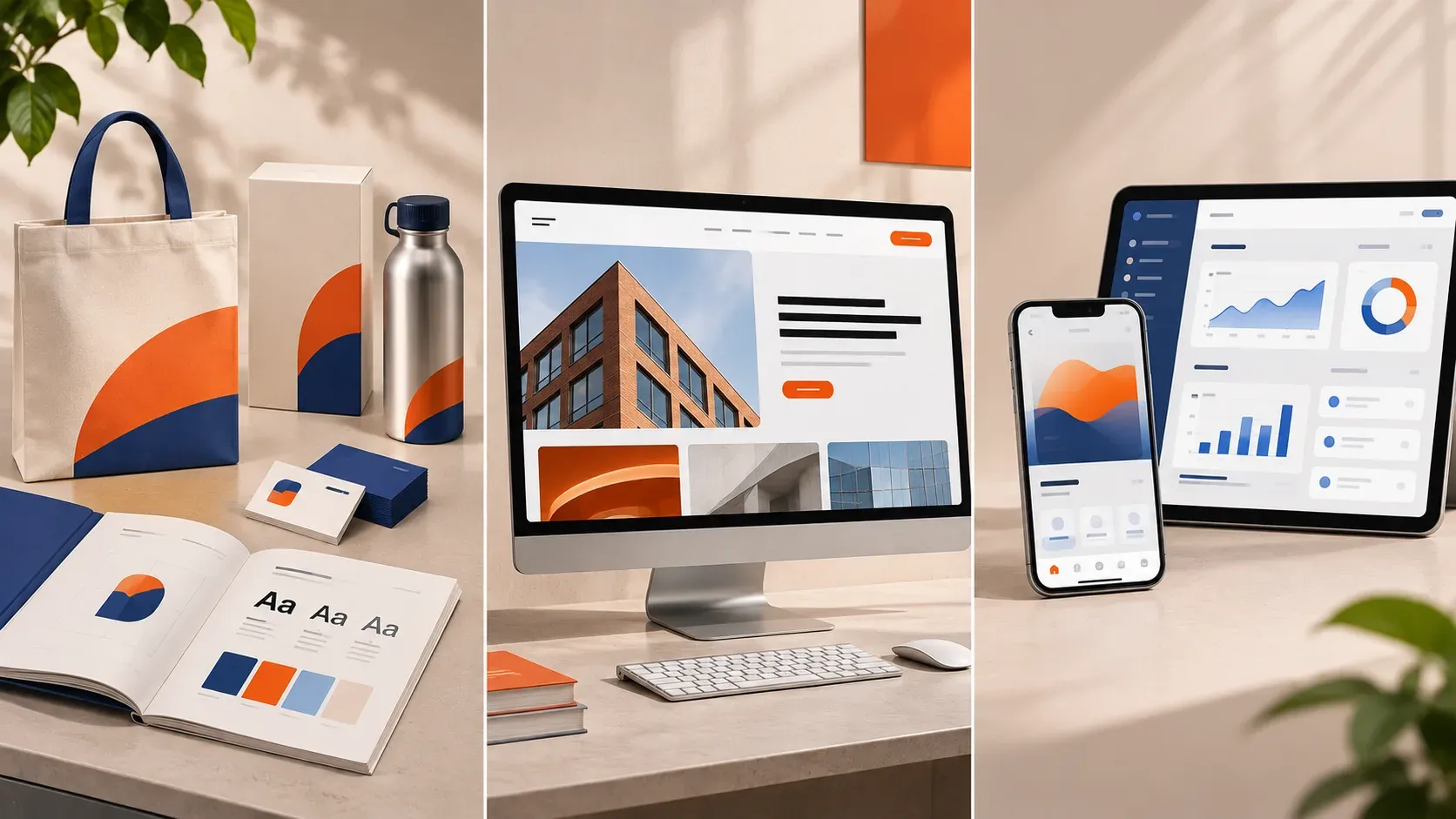
Think about the last time a product's website promised one thing, and the app delivered another. That gap is where users leave. Red Baton works on brand strategy and product design together, so the words your brand uses end up in the onboarding flow, the dashboard, and the sales deck.
That matters most for companies moving fast. A London scale-up that changes its positioning in March shouldn't be stuck with a product that still speaks the old language in June. If that's your situation, our fintech work is a good place to see how we approach it. Let's talk about what your product needs to say.
2. KOTA
KOTA builds creative websites for brands that want visitors to turn into customers. Their client list includes Gartner, which tells you they can handle demanding stakeholders. If your website looks nice but isn't bringing in enquiries, KOTA is worth a conversation. They're strongest on the web side, so pair them with a brand partner if your positioning is still unsettled.
3. The Web Kitchen
If you're running a charity, a social enterprise, or an educational body, your website has a job beyond selling. It has to recruit volunteers, move donors, and be usable by everyone, including people using assistive technology. The Web Kitchen builds custom WordPress sites for exactly these organisations and includes accessibility auditing and ongoing support. Their strength is dependable, mission-first building, so a full brand overhaul may need a separate partner.
4. Ragged Edge
Ragged Edge works out of Hatton Garden on challenger brands, the ones that want to break the mould in their category. Their work with Wise and Marshmallow shows how a distinctive voice can carry a brand through a crowded market, and their work on Granola shows how to make an AI product feel human. If you're in consumer fintech and want your tone to stand out while still passing compliance review, Ragged Edge should be near the top of your list. Plan separately for interface design.
5. Shoreditch Design Studio
Some projects are on a deadline that can't move. A product launch, a funding announcement, or an event where you need to be live by a fixed date. Shoreditch Design Studio builds sleek, fast websites for startups and international brands, with a lean team that can move quickly. If your priority is getting online well and soon, this is a practical choice.
6. Qubstudio
You know your product works, but users keep getting stuck. Maybe the onboarding takes too long, or the dashboard buries the feature that matters most. Qubstudio focuses on UX and UI for SaaS and fintech, with research at the centre of the work. They're a strong match if your brand direction is set and you need someone to make the complicated parts make sense.
7. Brand Purist
Founder-led businesses often go straight to a logo because it feels like progress. Brand Purist asks you to slow down first. Its structured sprints cover naming, verbal identity, and visual direction, with research into your audience before any design begins. If you're still deciding what your company should say, this approach saves you from redesigning in a year. You'll likely need a product or web partner once the brand work is done.
8. Koto
Koto builds digital brand systems for multinational tech and consumer companies, with work for Amazon, Tripadvisor, and Call of Duty. They think in systems, which is a good fit if you're running several brands across several markets and need every one of them to feel connected. For a single product at an early stage, you'll usually get more focus from a smaller partner.
9. Wolff Olins
Wolff Olins has been working in London since 1965 and is now part of Omnicom. Its work on the Lloyds Banking Group rebrand shows what happens when a brand has to change how staff, customers, and regulators see it all at once. Expect a large engagement, a senior team, and a budget to match. If your organisation is that size and that ambitious, this is the scale they operate at.
10. Pentagram
Pentagram has been a London institution since 1972, and its partners work directly with clients. Its reputation rests on identity, typography, and editorial design, so it's the standard other studios are measured against. For a product company, Pentagram is more useful as a reference point for craft than as a day-to-day partner. For a cultural institution or a design-led brand, it can be exactly the right call.
Which Stage Are You At?
Your stage determines what a design partner should focus on, so settle that question before you compare studios.
Pre-Seed and Seed
At this stage, the work is about getting a name, an identity, and a first product that people understand. Speed and clear decisions matter most, so look for a partner who can make calls quickly and doesn’t need months of discovery before showing concepts. Keep the scope tight. A focused identity and a usable first product will do more for you than a sprawling brand programme.
Series A and Growth
Once you have users and investor attention, the brand has to hold together across pitch decks, hiring pages, and the product itself. Inconsistency becomes visible fast. Consistency and handover matter more than speed here, so ask how the brand will be documented and how your team will apply it when the agency has left. Make sure whoever leads the work is involved in the decisions that shape the product, not only the visuals.
Enterprise and Multi-Market
Larger organisations manage several brands, subsidiaries, and approval chains. The question shifts from “what should we look like?” to “how do we keep this consistent across dozens of teams and markets?” Look for a partner who can explain how the brand system will be governed over time, who owns each decision, and how changes get approved without slowing everything down.
Whatever your stage, the same checks apply. Ask how the work will be reviewed, who makes the final call, and what your internal team will be able to maintain once the project is finished.
The Questions That Tell You Who's Good

A portfolio shows what a studio has made. These questions show how it works, and they'll tell you more in a single call than a dozen case studies.
Who will actually be doing the work? Ask for names and seniority. The person who pitches you should be involved in discovery, and you should know who's designing your screens.
Can you show me a brand that's live in a product? A logo on a slide is easy. Ask for a project where the identity went into a real interface, and what changed once it launched.
How do you handle regulated copy? If you're in fintech or insurance, you need to know the studio drafts within FCA rules and bring your legal team in early.
What will we be able to run without you? Ask whether you'll get a component library, usable guidelines, and a handover session. Files your own team can use will save you calls every time something small needs changing.
Does It Matter Where Your Studio Sits?
Where a studio is based changes how the design and brand work gets done, not just how quickly someone replies to an email.
A London studio has an advantage in research. It can recruit people from your target audience, sit with them in person, and watch how they react to a rough concept. It can also run a stakeholder workshop in your office and take the room through a brand direction in one session.
A remote studio can offer something different. It can draw on a wider pool of specialists, such as type designers, motion designers, and design-system engineers, whose skills may not be concentrated in one city. Research can still be run online with recruited participants, and many brand decisions can be made through recorded walkthroughs and written feedback. The trade-off is that the discussion takes more planning, because a five and a half hour time difference means decisions need a clear owner and a fixed review schedule.
Good brand work depends less on postcode than on how well a studio listens and how clearly it explains its choices.
Where to Go From Here
Choosing the right design agency in London comes down to matching your biggest problem to the studio whose strongest work solves it. If your brand, your product, and your website all need to say the same thing, you'll want a team that handles all three. If one of them is the real bottleneck, a specialist can get you further, faster. Use the list to narrow your options, then ask the questions above on your first call. If you'd like to see how Red Baton works across brand and product, start a conversation with us. We'd rather you talk to us and decide it's not the right fit than guess.
Frequently Asked Questions
How much do design agencies in London charge?
A small brand project with strategy and identity usually starts around £15,000. Combined brand and web work often falls between £40,000 and £90,000. Larger programmes with product design and rollout can go past £100,000. Ask each studio for a fixed-scope proposal so you can compare what's included, not just the headline price.
What's the difference between a branding agency and a product design agency?
A branding agency works out your positioning, name, and visual identity. A product design agency designs the screens people use, from sign-up to dashboard. Many London companies need both, so look for a team that can sequence the work or covers both under one roof.
Should I hire a London studio or a remote one?
Start with the kind of decisions you expect to make. If your brand direction depends on in-person sessions with leadership, or on testing concepts with people in London, a local studio will make those steps easier. If you need specialist design skills and you’re comfortable running structured reviews across time zones, a remote studio can deliver the same quality, often with more depth in a particular discipline.
Many companies take a hybrid route. They bring in a local strategist to run research and stakeholder sessions, then hand production and the design system to a remote team. The key is agreeing on who signs off each stage before the work begins
Can design agencies in London also help with marketing?
Some do, and it’s worth asking. Many studios can produce campaign assets, social templates, and landing pages alongside the identity. The important question is whether that marketing work sticks to the brand system or drifts into separate campaigns with their own look. A studio that designs the identity and the campaign materials together usually keeps the message consistent across every channel your customers see..
How long does a brand and website project take?
A focused identity with a website usually takes 8 to 12 weeks. Bigger projects with product work and regulatory review often run 16 weeks or longer. Timelines stretch when approvals pass through several senior people, so plan those reviews into the schedule from the start.
What should I look for in a case study?
Look for the business problem, the constraints the team had to work within, what they built, and what changed afterwards. Be wary of case studies that only show the finished visuals. If the outcome matters to your decision, ask to speak with a past client.
Do fintech brands in London need special design rules?
Yes. Financial promotions in the UK are regulated by the Financial Conduct Authority, which affects headlines, disclaimers, and calls to action. A studio working in fintech should draft within those rules from the first concept and involve compliance early.
Share blog on:


Chatter about
Design & random stuff