


Would You Pay $30,000 for a Car You Can't Drive? Inside Tesla's Cybercab Bet
By Ronak Daga
Sep 23, 2026
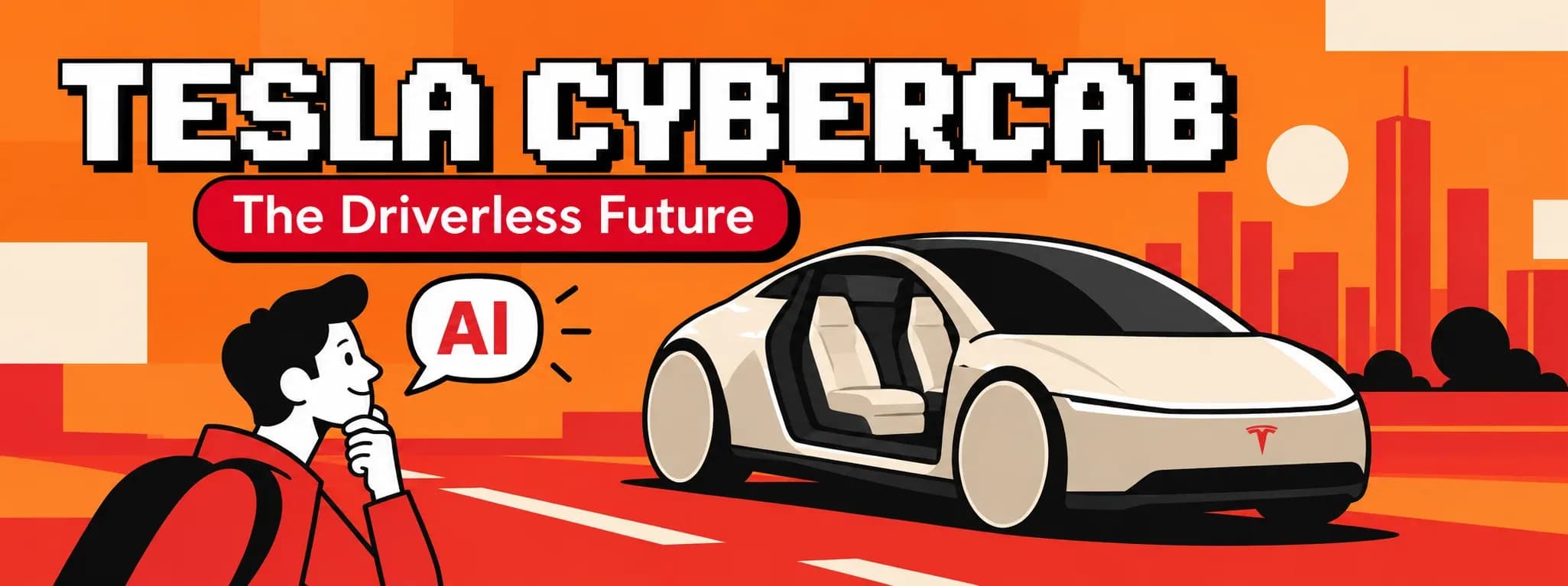
Would you pay $30,000 for a car you can't drive? That sounds ridiculous, until you actually look at what Tesla just built.
There's no steering wheel. No pedals. It only seats two people. And Tesla wants close to $30,000 for it.
This is the Cybercab, and the more you dig into why Tesla built it this way, the clearer it becomes: this was never meant to be a car for drivers. It's a bet on a future where cars don't need us at all.
A car built to remove the driver, not assist one
Most of the "self-driving" conversation over the last decade has been about cars that can drive themselves *if needed*, with a steering wheel still there as a backup.
The Cybercab skips that entirely.
It's a two-seat electric coupe with no steering wheel, no accelerator, and no brake pedal, because Tesla isn't designing around a human backup driver at all.
Tesla has said the reasoning comes down to how people actually use ride-hailing: research showing that the vast majority of trips carry only one or two passengers is what shaped the two-seat layout, letting Tesla cut size, weight, and manufacturing cost.
Under the hood, it runs a single electric motor, a fairly modest battery pack for an EV, and Tesla's now-familiar bet that cameras and AI, not radar or LiDAR, are enough to drive safely without a human in the loop.
That's a real departure from how competitors like Waymo approach the same problem, and it's still the most contested part of Tesla's whole strategy.
Elon Musk put the price at under $30,000 back in 2024, and Tesla has stuck to that number publicly, but as of now the company hasn't confirmed a final retail price or opened it up for individual purchase.
It's already showing up in American cities
This isn't a concept car sitting in a design studio.
Tesla is already running driverless robotaxi service in several U.S. cities, and it's been expanding city by city rather than launching everywhere at once.
Charlotte is one of the more interesting recent additions. Roughly a dozen Cybercabs and an equal number of Model Ys, all wearing Texas plates, showed up staged in a parking lot there, around the same time Tesla started hiring local "AI Safety Operators" to monitor the service.
Charlotte matters for another reason too: Waymo has already been testing there for months, which makes the city one of the first places where Tesla's driverless approach and Waymo's sensor-heavy approach are operating in the same market at the same time.
The real problem Tesla is trying to solve
Here's the part that actually explains why the Cybercab looks the way it does.
If you want thousands of autonomous taxis on the road, you need thousands of vehicles.
Tesla has two ways to get there: buy and own every single one of them itself, or sell the car to someone else and let their vehicle join Tesla's network.
Owning the entire fleet outright is enormously capital-intensive.
Selling the car to individuals or businesses and inviting them to put it to work in Tesla's robotaxi network is a very different, much lighter way to scale.
That's the idea Tesla has started floating publicly.
Ahead of a Cybercab event in Austin, the company put out an interest form asking businesses whether they'd want to participate in the robotaxi network, whether through buying a fleet, running a "mobility hub," or other arrangements.
It's worth being precise about where this actually stands: it's an interest form, not a finished program.
There's no confirmed price for fleet buyers, no published revenue split, and no guarantee the option ever opens up to individual owners the way it's being talked about online.
Before you get too excited about "your car earning money"
The pitch is appealing: your car sits outside your house doing nothing most of the day, so why not let it work while you're not using it?
It's worth hearing the skeptical case too, because it's a serious one.
If running a Cybercab fleet were reliably profitable, the argument goes, Tesla would have strong reason to keep every vehicle for itself rather than selling the asset and the risk to someone else.
Fleet buyers would be the ones absorbing the purchase cost and depreciation, while Tesla keeps the software margins and full control over pricing, app placement, and which cars get priority.
There's also a precedent worth knowing about.
A Dutch leasing company bought thousands of Teslas on a similar robotaxi-income pitch and went bankrupt in late 2025 after the promised income never showed up fast enough to offset depreciation.
And Tesla itself made a nearly identical pitch to owners back in 2019 with its original "Tesla Network" concept, projecting significant annual income per vehicle that never materialized for most owners.
None of that means the fleet idea is doomed.
It does mean anyone thinking about it as a source of guaranteed income should wait for actual confirmed terms, not the pitch.
What "owning a car" might come to mean
Set aside the investment angle for a second, because the more interesting shift is a simpler one.
Right now, your car is an asset that mostly sits still.
It's parked at your house, parked at work, parked outside the store, for the overwhelming majority of its existence.
The Cybercab is Tesla's bet that this doesn't have to be the default anymore, that a vehicle can be productive even when you personally have no use for it in that moment.
Whether that turns into a real, working business model for regular owners, or stays a narrower service run mostly by Tesla itself, is still an open question.
But it's a genuinely different way to think about what a car is for, and that's probably the real idea behind the Cybercab.
Share blog on:


Elon Musk said in 2024 that it would cost under $30,000, and Tesla has repeated that target, but as of September 2026 the company hasn't confirmed a final retail price. It isn't yet available for individual purchase.
Tesla designed the Cybercab exclusively for autonomous operation rather than as a car a person drives. It relies on camera-based AI and Tesla's Full Self-Driving neural networks instead of a human driver or the radar/LiDAR sensors other robotaxi companies use.
Tesla has floated this idea and put out an interest form asking businesses about fleet purchasing ahead of a Cybercab event in Austin, but as of September 2026 there's no confirmed pricing, qualification process, or revenue split for individual owners. It remains an exploratory plan, not a finalized program.
Tesla currently runs driverless robotaxi service in Houston, Dallas, Austin, Miami, Orlando, and Tampa, with expansion into cities like Charlotte, Las Vegas, and Phoenix. In Charlotte specifically, around 14 Cybercabs and 14 Model Ys with Texas plates were spotted staged in a parking lot as Tesla hired local safety operators, and Waymo has separately been testing there for months.
That's genuinely unresolved. Critics point out that if fleet ownership were reliably profitable, Tesla would likely keep the vehicles itself rather than selling them, and note that Tesla made similar unfulfilled income promises for owners back in 2019 with its original Tesla Network pitch. This is a business decision with real financial risk, not a guaranteed income stream, so treat any specific earnings claims with caution until Tesla confirms firm terms.
Chatter about
Design & random stuff